PRMS - Project Risk Management Specialist Training
PRMS · Project Risk Management Specialist
Live cohort · Starts September · 6 sessions online
Become the Risk Manager. Not the planner who does risk on the side.
You have been handed a risk register, or asked to run a workshop, on top of your real job. You did your best and quietly hoped no one looked too closely. PRMS ends that. In six sessions you install the core discipline every Risk Manager is expected to have: writing risks that hold up, running a workshop people respect, sourcing real evidence for your scores, and reporting to decision-makers. You walk out doing the job, and interview-ready for the title.
You think you have no risk background. You are wrong. Your schedule and cost data are the raw material the whole discipline is built on.
Sit the first live session. If it is not for you, full refund, no questions. The risk sits with us.
A two-minute look at exactly what you will learn and build.
The market
The role you want has a gate. Right now you are on the wrong side of it.
Risk Manager, Risk Lead, and senior project controls roles increasingly ask for a real risk skill set: not "familiar with risk," but able to build a register, run the workshop, justify the numbers, and brief the decision. Most project controls professionals were never taught this. They pick up fragments on the job and stay stuck one grade below the title.
Write risk properly
A register in WHY/WHAT/HOW that survives a project director's scrutiny.
Run the room
Plan and facilitate a workshop engineers take seriously.
Justify the number
Source real evidence for impact and probability instead of guessing.
These are the essentials. Master them and you stop being the planner who helps with risk. You become the Risk Manager.
The IQRM method · The Evidence Method
It starts with where your numbers come from, the thing most risk registers cannot answer.
Ask most people why a risk is scored 4 by 3 and you get a shrug. That is opinion with a number attached. PRMS teaches the Evidence Method: how to find real support for your impact and probability assessments inside the reports, records, and data you already have access to. This is the foundation of IQRM's Risk Data Engine philosophy: stop guessing, start sourcing.
Where PRMS ends and QRM begins. PRMS teaches you to find the evidence. QRM teaches you to turn it into a model, fitting distributions, running Monte Carlo, feeding Safran Risk. PRMS ends at "here is the evidence behind the score." QRM begins at "here is how to model it." You will want both.
Why this, not a generic risk course
A discipline you practise, not definitions you memorise.
A typical risk course
- Teaches definitions and theory you already half-know
- Leaves you with a template but no judgement
- No idea how to run the room or defend a score
- Nothing you can show in an interview
PRMS
- Teaches the discipline as it is actually practised
- You leave doing the job, not describing it
- You can write, facilitate, evidence, and report
- Real deliverables and a certificate you can point to
The essentials are learnable in six sessions. Most people wait years for them on the job.
Sit session one. Not for you? Full refund.
Curriculum
The PRMS curriculum: six sessions across three stages.
Stage 1 · Foundation
Risk as a discipline, and the WHY/WHAT/HOW risk statement
What a Risk Manager actually owns, and how to write risk statements that hold up under a project director's scrutiny.
Building a risk management plan
From a blank page to a one-page plan that sets scope, roles, cadence, and escalation for a real project.
Stage 2 · Capability
Facilitating a risk workshop that works
Plan the session, control the room, and leave with a register engineers actually stand behind.
The Evidence Method: sourcing real data for impact and probability
Replace gut-feel scoring with support drawn from the reports, records, and data you already have access to.
Stage 3 · Identity
Risk status reporting for decision-makers
Turn the register into a report senior management reads, understands, and acts on.
Capstone review and mock exam
Close on the case study, review your deliverables, and sit the mock exam that leads to your certificate.
Capstone project. You close on a real case-study dataset and submit a properly written risk register, a risk management plan, and a risk status report. Real conditions, real deliverables, the kind you can point to in an interview.
What you will build
A real register, workshop, and report, built by your own hand.
Not slides about risk. The actual deliverables a Risk Manager produces.
The risk register
Written in WHY/WHAT/HOW. Clear, defensible statements.
The one-page plan
A risk management plan set up from a blank page.
The workshop
A facilitation pack and a session output people stand behind.
The status report
A risk status report written for senior management.
Real project, real data
Built on a real project, not a textbook example.
You work a genuine project case study: real scope, real register, real stakeholders. You write the risks, run the workshop, source the evidence, and produce the report exactly as you would on Monday morning.
The result you walk away with
Your own register, plan, and report. Built by you.
This is not a course you sit and watch. By the end you have produced the core deliverables of the role, from a blank page to something you can defend and show.
In six sessions, those deliverables carry your name.
Sit session one. Not for you? Full refund. The risk sits with us.
What you will be able to do
From helping with risk to owning it.
- Write a risk register in WHY/WHAT/HOW that holds up under scrutiny.
- Build a risk management plan from a blank page.
- Plan and facilitate a risk workshop that engineers respect.
- Source real evidence for impact and probability instead of guessing.
- Report risk status in a way that drives a decision.
- Walk into a risk interview able to prove you can do the work.
This is for you if
- You come from planning, cost, scheduling, or project controls
- You have been handed risk work and want to do it properly
- You want the Risk Manager title, not just the tasks
This is not for you if
- You already run quantitative risk models (go straight to QRM)
- You want a certificate without doing the work
- You expect to watch passively rather than build
Proof
A method built in practice, not in a classroom.
"A great course for new entrants into project risk management. I'm a practising risk and project controls professional and was a great refresher on best practise outside of Australia which is very aligned around risk management supporting decision making."
"For me it was perfect length and tackled the key themes for risk management as a precursor to the iQRM diploma which I am looking forward to undertaking next."
Practising risk and project controls professional · verified course feedbackScreenshot of the original review available on request.
Career pathway
PRMS gets you in. The Pathway gets you the pay rise.
UK risk roles increasingly screen for QSRA capability. Per PACE Global, the UK's leading project controls and risk recruitment firm, that capability carries a 12 to 16% salary premium. PRMS gives you the discipline to enter risk. QSRA, taught in QRM, is what unlocks that premium. Take the Complete Risk Manager Pathway to get both.
Your instructor
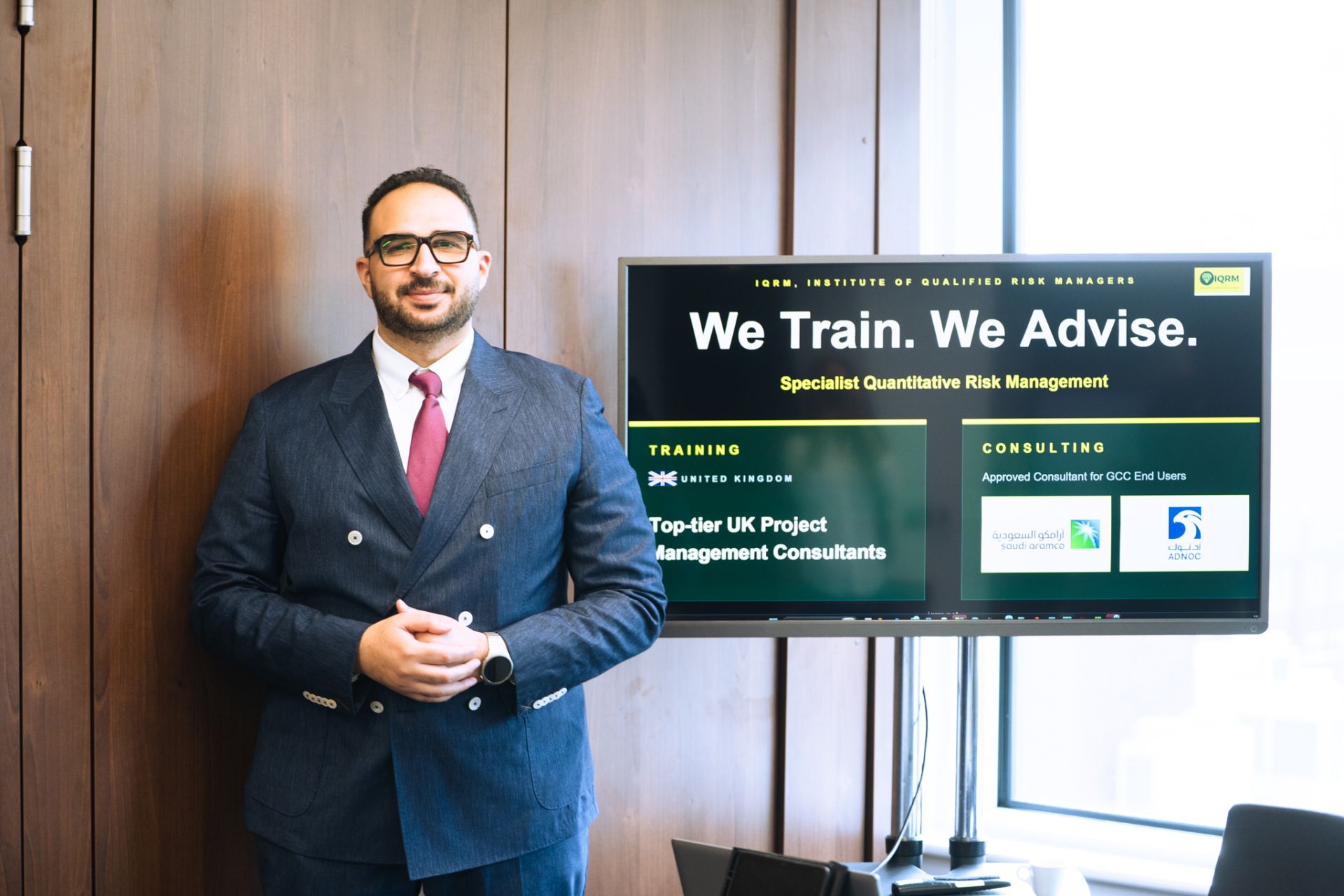
Rami Atef Salem, QRMCert
Rami has 15+ years in oil and gas risk management and is an Approved Consultant for both Saudi Aramco and ADNOC. He runs risk on live capital programmes and has guided a large number of professionals through the move from project controls into risk.
You learn the discipline from someone who does it on live programmes, not from a textbook.
What you take back to work
Every template we use is yours to keep.
You do not start from a blank page on your next project. You leave with the working files from the training, ready to use on Monday morning. The full toolkit, worth £95, is included at no extra cost.
- ✓
The PRMS Field Book (eBook)
The programme's reference companion, on your platform throughout and after the course.
- ✓
A WHY/WHAT/HOW risk register template
A structured register you can deploy on a live project immediately.
- ✓
A risk management plan template
The one-page plan format you build in Stage 1, ready to adapt.
- ✓
A workshop facilitation pack
Agenda, prompts, and capture sheets for running the room.
- ✓
A risk status report template
The management-facing report format from Stage 3.
Certification
Earn the PRMS Certificate. Proof you can do the core risk role.
Awarded on completion of the training, the capstone, and a mock exam. It is evidence you can write, facilitate, evidence, and report, the essentials every Risk Manager is expected to have.
It is also your first step toward the QRMCert. professional designation, earned through the Pathway.
Investment
Two ways to start.
PRMS live cohort
- 6 live sessions, September to early October (recorded, 365-day access)
- PRMS Field Book and all templates
- Capstone and mock exam
- PRMS Certificate
- Spreadsheets only, no paid software
Complete Risk Manager Pathway
- Everything in PRMS, plus:
- The full QRM Professional Programme (QSRA, QCRA, Monte Carlo, Safran Risk)
- The path to the QRMCert. designation
The first-session guarantee
Sit the first PRMS session. Not for you? Full refund before session two. 100% refundable. The risk sits with us.
For teams and employers
Bring your controls team up to a common risk standard.
Run a private PRMS cohort for your project controls team, built on your own project data, invoiced to your organisation.
Questions
Frequently asked.
Become the Risk Manager, not the planner who does risk on the side.
The next PRMS cohort begins September.
CPD certified · Approved Saudi Aramco vendor · ADNOC approved consultant