QSRA consulting · UK and GCC

QSRA Consultants: Quantitative Schedule Risk Analysis for Major Projects

A QSRA consultant uses Monte Carlo simulation on your project schedule to show how likely you are to hit your completion date, which risks drive the delay, and how much schedule contingency you need. You get a defensible P50 and P80 date instead of a single optimistic finish date.

Approved Saudi Aramco vendor · ADNOC approved consultant · 60+ projects · 15+ years of applied practice
What you getP50 and P80 dates, the ranked risk drivers, and a mitigation plan your board can act on
How longTypically 2 to 4 weeks for a standard schedule, including workshops and reporting
Who it is forOwners, EPC contractors and PMCs on capital projects, from FEED to execution
WhereUK, Saudi Arabia, UAE, Qatar, Oman, Kuwait and Bahrain, on site or remote

When you need a QSRA

A deterministic Primavera P6 date tells you what happens if everything goes to plan. It says nothing about how likely that is. A QSRA becomes necessary when the cost of being wrong is high:

Sanction and funding gates

Final investment decisions, IPA assurance reviews in the UK and lender reviews all expect a probabilistic schedule, not a single date.

Owner and contract requirements

GCC owners increasingly require quantitative schedule risk analysis before they approve a baseline programme. UK contracts under NEC4 put the programme at the centre of every compensation event.

Interfaces you cannot see in CPM

When several contractors share the critical path, delays compound in ways the critical path method does not show. Simulation does.

Real uncertainty

Shutdown and tie-in windows, long-lead equipment, marine weather, first-of-a-kind scope. Where the inputs are uncertain, a single date is a guess.

How a QSRA engagement works

  1. Schedule health check

    Before any simulation, we test your P6 or Microsoft Project schedule for open ends, hard constraints, lags and broken logic. A Monte Carlo run on a broken network produces a confident wrong answer.

  2. Calibrated inputs with the Risk Data Engine

    Most QSRAs fail on their inputs. We use the Risk Data Engine (RDE) method to build three-point estimates from productivity records, procurement data and performance history, then challenge expert opinion against that evidence.

  3. Risk mapping and correlation

    We map duration uncertainty, discrete risk events and calendar risks such as heat, wind and seasonal shutdowns onto the activities they affect, and set correlation so the model does not understate combined risk.

  4. Monte Carlo simulation

    We run the model in Safran Risk or Primavera Risk Analysis, with thousands of iterations and a locked seed so results are reproducible.

  5. Decision readout

    We present the result to the people who have to act on it: the P80 date, the drivers behind it, and the mitigations that move the curve.

What you receive

Not a PDF of charts. A small number of outputs, each tied to a decision.

100%80%50%0% Deterministic date (about P10) P50 P80 Completion date
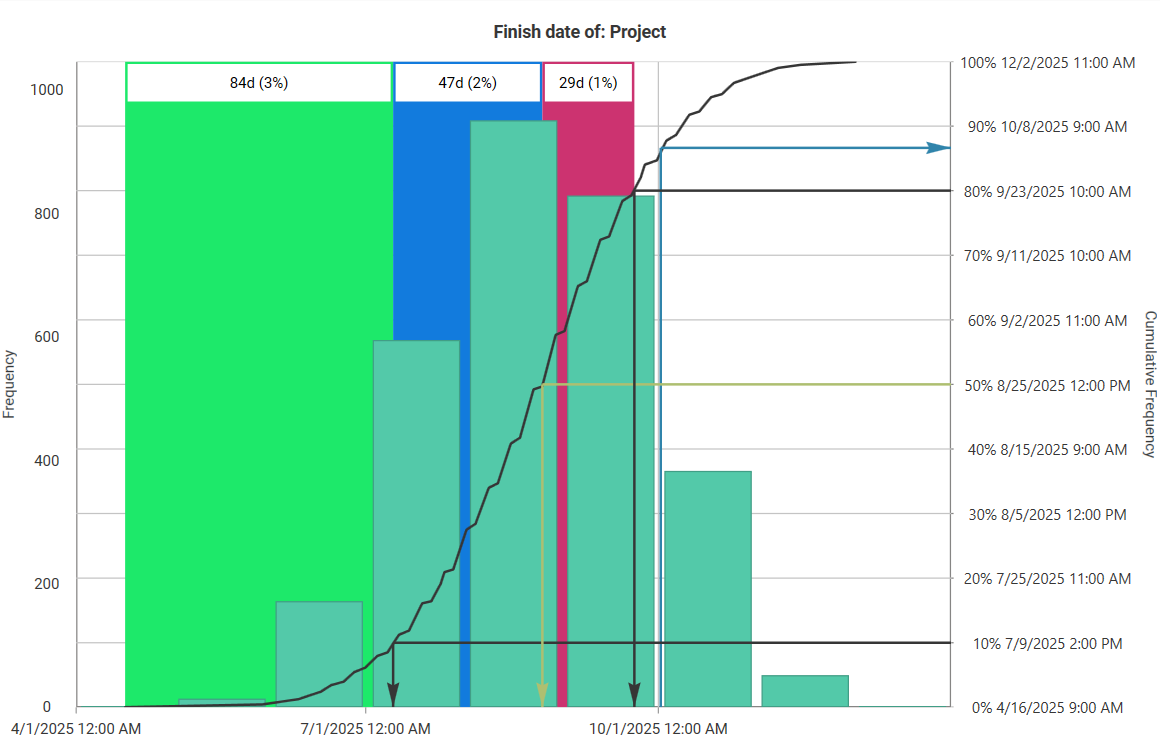
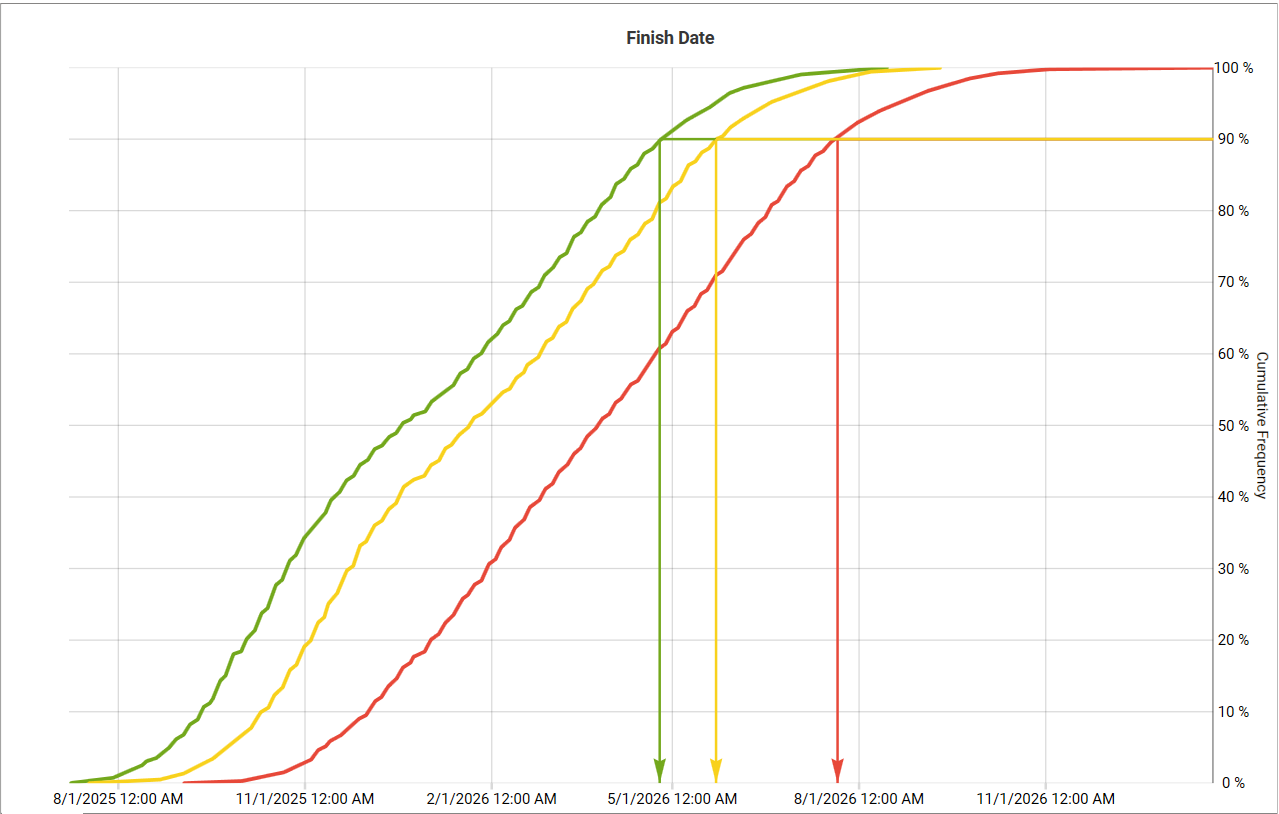
The S-curve. Illustrative. The probability of finishing by any date. It shows how far your deterministic date sits below P50, and what schedule contingency a P80 commitment needs.
Long-lead equipment deliveryShutdown window availabilityTie-in productivityPermit approvalsMarine weather downtimeCommissioning duration Contribution to finish-date spread
The tornado chart. Illustrative. The risks ranked by how much finish-date spread they cause. It tells you where mitigation effort changes the outcome and where it does not.

P-dates you can commit to

P50, P80 and P90 completion dates, with the schedule contingency each one needs over your baseline.

Ranked risk drivers

The top activities and risks behind the delay, so the mitigation budget goes where it moves the date.

Joint confidence, on request

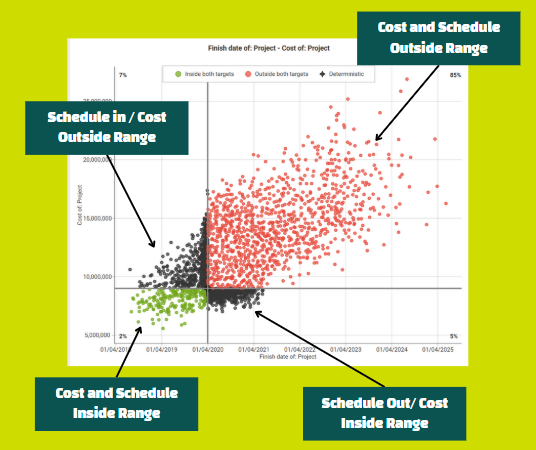
If you need it, we integrate cost and schedule into a Joint Confidence Level analysis so you can see the probability of meeting both.

QSRA Consultants: Expert Schedule Risk Analysis Services (QSRA) — Global & GCC

What does a QSRA consultant do?

A QSRA (Quantitative Schedule Risk Analysis) consultant uses Monte Carlo simulations to quantify the impact of uncertainty and discrete risks on a project schedule. Unlike traditional planners, they provide probabilistic forecasts (e.g., P80 completion dates), identify true critical path drivers, and recommend data-driven contingency levels to ensure projects finish on time and within budget.
Write your awesome label here.

Why Global Mega-Projects Require Specialist QSRA Consultants?

In modern infrastructure, energy, and construction, a static Primavera P6 schedule is no longer enough to guarantee success.

When billions are at stake, "guessing" the completion date leads to catastrophic liquidated damages.

This is where
QSRA consultants bridge the gap between optimistic planning and reality.

Expert Schedule Risk Analysis services move beyond the limitations of qualitative heat maps. By applying rigorous mathematical models to your project's logic, a consultant transforms a single-point completion date into a range of probabilistic outcomes.

Safran Risk Schedule Risk Analysis Consultant

When to Hire a QSRA Consultant?

Not every project requires a full quantitative simulation. However, hiring a specialist becomes non-negotiable under the following conditions:

  • Capital Expenditure (CAPEX) Thresholds: Projects exceeding $100M typically require a QSRA for Final Investment Decision (FID) approval.

  • Contractual Mandates: Owners in the GCC (Saudi Aramco, NEOM, ADNOC) increasingly mandate third-party Quantitative Risk Assessment services.

  • Complex Interdependencies: When multiple sub-contractors share a critical path, the "compounding delay" effect is invisible to standard CPM tools.

  • High Uncertainty: Novel technologies or unstable supply chains make deterministic forecasting impossible.


How Our QSRA Consulting Process Works?

At IQRM, we don't just "run a model." We follow a proprietary workflow developed by Rami Salem to ensure the outputs are defensible at the board level.

1. Schedule Health Check (The Foundation)

Before a simulation can begin, we perform a "Stress Test" on your Primavera P6 or MS Project file. We identify open ends, constraints, and "hidden" logic that would invalidate a Monte Carlo run.

2. Risk Data Engine (RDE™) Calibration

The biggest failure in QSRA is "Garbage In, Garbage Out." We use the Risk Data Engine method to calibrate expert judgment, removing optimism bias from duration ranges (Min, Likely, Max).

3. Integrated Risk Mapping

We map your quantitative risk register directly to the schedule activities. This includes:

  • Duration Uncertainty: Normal variance in productivity.

  • Discrete Risk Events: Weather, strikes, or equipment failure.

  • Calendar Risks: Modeling sandstorms or seasonal shutdowns.

4. The Monte Carlo Simulation

Using industry-leading tools like Safran Risk or Acumen Risk, we run 5,000+ iterations. This generates the "S-Curve" and the Tornado Chart—the most critical report for any Project Director.
The Value: 3 Key Deliverables You Receive

When you engage IQRM for QSRA consulting, you receive more than a PDF. You receive a roadmap for mitigation:

  1. The P-Date Commitment: We identify the date your project has an 80% (P80) chance of hitting, allowing for realistic stakeholder management.

  2. Sensitivity Analysis (Tornado Chart): A ranked list of the top 10 activities or risks causing the most delay. This tells you exactly where to spend your mitigation budget.

  3. Joint Confidence Level (JCL): If requested, we integrate cost and schedule to show the probability of meeting both objectives simultaneously.

Common Mistakes in Hiring QSRA Support

  • Hiring "Software Drivers" over "Risk Strategists": A consultant who only knows how to click buttons in Safran Risk without understanding project controls will produce flawed results.

  • Late Engagement: Performing a QSRA two weeks before a deadline is "check-box" compliance. The most value is gained during the FEED or tender stage.

  • Ignoring Schedule Logic: A Monte Carlo simulation is only as good as the Critical Path. If the logic is broken, the simulation is a fantasy.

Pro Tip: Always ask your consultant how they handle correlation. If they treat every risk as independent, they are likely underestimating your project's total risk exposure by 30% or more.


How to Choose the Right QSRA Partner

Look for a partner who offers a blend of consultancy and capability building. At IQRM, we offer a "Done-With-You" approach.

While we execute the Schedule Risk Analysis services, we also empower your internal team through our QRM Diploma + AI training to ensure the culture of risk management survives after the consultant leaves.

Ready to Quantify Your Project’s Success?

Don't leave your project completion to chance. Our QSRA consultants provide the clarity needed to protect your margins and your reputation.

[Contact IQRM for a QSRA Consultation Inquiry]
IQRM's Consultations Work Experience
Consultant or in-house?

External QSRA consultantIn-house team
Best whenA sanction gate, owner requirement or contract dispute needs an independent, defensible forecastYou need regular updates on a stable schedule and already hold the tools and skills
IndependenceNo stake in the baseline, which is what reviewers and boards look forCloser to the programme, which makes challenge harder
SpeedMobilises with a proven method and templatesDepends on team capacity and experience
Long-term capabilityStays with you only if knowledge is transferredBuilds over time

Many clients do both. We run the first QSRA with your team and train them to maintain it through the QRM Professional Programme, so the capability stays after we leave.

Common mistakes when buying QSRA support

Hiring a software operator

Someone who can run Safran Risk but does not understand project controls will produce a model that looks right and fails under challenge.

Starting too late

A QSRA two weeks before a deadline is compliance, not analysis. The most value comes at FEED, tender or baseline approval.

Ignoring schedule logic

A simulation is only as good as the network underneath it. If the logic is broken, the P80 is fiction.

Treating risks as independent

Ask how your consultant handles correlation. A model that treats every risk as independent understates total exposure.

Who leads the work

RS

Rami Salem, founder of the Institute of Qualified Risk Managers, leads IQRM consulting engagements. He has more than 15 years of quantitative risk practice on oil and gas, EPC and infrastructure capital projects across the GCC, and IQRM is an approved risk management consultant to Saudi Aramco and ADNOC.

Read Rami's profile

Where we deliver

On site or remote across the UK, Saudi Arabia, the UAE, Qatar, Oman, Kuwait and Bahrain. Typical scopes include brownfield tie-ins, shutdown windows, offshore and marine work, remote logistics and multi-party interfaces.

For Gulf projects, see QSRA consultants in Saudi Arabia and the UAE. For training your own team, see QSRA training in the UK.

Frequently asked questions

How long does a QSRA engagement take?
For a standard schedule, a full analysis including workshops and reporting typically takes 2 to 4 weeks. Most of that time goes into the schedule health check and the input workshops, not the simulation.
Which software do you use?
We work mainly in Safran Risk for its correlation handling and integrated cost and schedule features. We also work in Primavera Risk Analysis.
Can you work with our P6 or Microsoft Project schedule?
Yes. We import P6 XER or Microsoft Project XML files, fix integrity issues, and return a clean network you can keep using.
What is the difference between SRA and QSRA?
The terms are often used interchangeably. SRA stands for schedule risk analysis; the Q emphasises that the analysis is quantitative, using Monte Carlo simulation.
Do you provide Joint Confidence Level (JCL) analysis?
Yes. We integrate your cost estimate with the schedule so you can see the probability of meeting cost and schedule targets together.
Do you facilitate the risk workshops?
Yes. Facilitation is a core part of the service. We use the Risk Data Engine method so that workshop inputs are tested against evidence rather than taken on opinion.
Can you review a QSRA someone else built?
Yes. We review existing models for schedule logic, input quality, correlation and reporting, and tell you whether the P80 will stand up to challenge.
Do you work in both the UK and the GCC?
Yes. We deliver across the UK, Saudi Arabia, the UAE, Qatar, Oman, Kuwait and Bahrain, on site or remotely.

Talk to us about your schedule

Tell us about the project, the stage it is at and the decision coming up. We will tell you whether a QSRA is the right tool, and what it would involve.

info@iqrm.net · +971 50 362 5784 · Rolex Tower, Sheikh Zayed Road, Dubai

Information

Address
Rolex Tower, Sheikh Zayed Road, Dubai, UAE
Phone
+971503625784
E-mail
info@iqrm.net

Book your Free QSRA Clarity Call

First Name
Last Name
E-mail address
Type of work needed?
Thank you!

Frequently asked questions

Q1: How long does a typical QSRA engagement take?

For a standard schedule, a comprehensive analysis—including workshops and reporting typically takes 2 to 4 weeks

Q2: Which software do your consultants use?

We primarily use Safran Risk due to its superior correlation handling and integrated cost/schedule features. We also support Primavera Risk Analysis (OPRA).

Q4: What is the difference between SRA and QSRA?

They are often used interchangeably. SRA stands for Schedule Risk Analysis; the "Q" emphasizes the Quantitative (Monte Carlo) nature of the assessment.

Q5: Do you provide JCL (Joint Confidence Level) reports?

Yes. We integrate your cost estimate with the schedule to provide a 3D scatter plot showing the probability of success across both dimensions.

Q6: Can you help with "Risk Calibration" workshops?

Yes. Facilitating the workshop is a core part of our service. We use the RDE™ method to ensure your team's inputs are realistic and unbiased.

GCC & Global delivery

KSA, UAE, Qatar, Oman, Kuwait, Bahrain, UK, US. Brownfield tie-ins, shutdown windows, remote logistics, multi-party interfaces.
Write your awesome label here.

Information

Address
Write your address here
Phone
Write your phone number here
E-mail
Write your e-mail address here

Book you Free QSRA Clarity Call

First Name
Last Name
E-mail address
Type of work needed?
Thank you!
Created with