Written by Rami Salem, Quantitative Risk Management specialist with 15+ years of experience across Oil & Gas, EPC/EPCM, and infrastructure mega-projects.
The project manager reports that the schedule risk analysis shows an 80% confidence of finishing by December. The cost risk analysis shows an 80% confidence of staying within $450 million. The board approves the contingency based on these numbers. Everyone assumes the project has an 80% chance of success.
It does not. The actual probability of achieving both targets simultaneously is closer to 55% to 65%. The board just approved a project with a roughly coin-flip chance of delivering on time and on budget, while believing they had 80% confidence.
Joint Confidence Level (JCL) is the probability of achieving both the schedule target AND the cost target at the same time. It is always lower than the individual confidence levels because time and cost risks are interconnected: schedule delays increase time-dependent costs, and cost overruns can force schedule acceleration. JCL analysis, produced through Integrated Cost and Schedule Risk Analysis (ICSRA), is the only way to give executives an honest answer about total project risk.
This guide explains what JCL is, why it is always lower than you expect, and how to build the integrated model that produces it.
The Mathematical Problem: Why Individual P-Values Are Misleading
To understand why JCL is lower than individual confidence levels, consider a simplified example.
Assume schedule risk and cost risk are completely independent (which they are not, but it illustrates the point). If you have an 80% chance of meeting the schedule and an 80% chance of meeting the budget, the probability of achieving both is:
0.80 × 0.80 = 0.64 (64%)
That is already significantly lower than 80%. But it gets worse. In reality, schedule and cost are positively correlated: when the schedule slips, costs increase because of indirect cost prolongation (supervision, equipment rental, site facilities). This positive correlation pushes the JCL even lower than the simple multiplication suggests.
Typical finding from IQRM's project experience: A project with P80 schedule confidence and P80 cost confidence typically shows a JCL of 50% to 65%. The exact number depends on the proportion of time-dependent costs, the strength of the schedule-cost link, and the specific risk drivers.
Key insight: Reporting P80 on schedule and P80 on cost separately gives executives a false sense of security. JCL is the only metric that tells the truth about the combined probability of project success.
What Is Integrated Cost and Schedule Risk Analysis (ICSRA)?
ICSRA is the method that produces JCL. It combines the schedule risk model and the cost risk model into a single integrated Monte Carlo simulation where schedule delays automatically trigger cost increases.
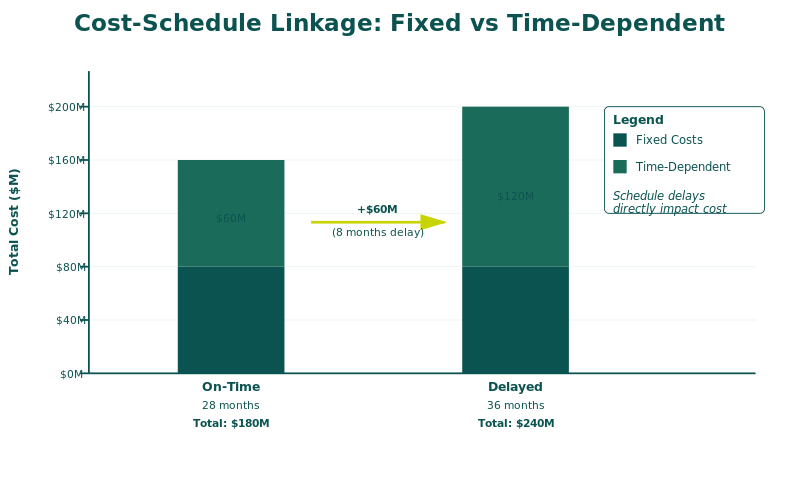
The critical concept is the distinction between fixed costs and time-dependent costs:
Fixed Costs
These do not change regardless of how long the project takes:
• Equipment purchase prices
• Material quantities (if scope does not change)
• Lump-sum subcontract values
• Design and engineering fees (if fixed-price)
Fixed costs have their own uncertainties (quantity variation, price fluctuation) but these uncertainties are independent of the schedule.
Time-Dependent (Variable) Costs
These accumulate based on project duration:
• Project management team salaries
• Construction supervision
• Equipment and crane rentals
• Temporary site facilities
• Insurance premiums
• Office and IT costs
These costs are typically expressed as a monthly "burn rate." On a large EPC project, the indirect cost burn rate is often $2 million to $10 million per month. Every month of delay adds this burn rate to the total project cost.
Why This Matters
In a traditional QCRA (cost-only analysis), time-dependent costs are estimated as a lump sum based on the planned duration. If the project is planned for 36 months and indirect costs are $5 million per month, the QCRA includes $180 million for indirect costs.
But if the schedule risk analysis shows the P80 finish date is 3 months late, those indirect costs should be $195 million ($5M × 39 months), not $180 million. The traditional QCRA misses this $15 million.
ICSRA solves this by linking indirect costs to hammock activities that automatically extend when the schedule is delayed during simulation. Each Monte Carlo iteration calculates both the finish date AND the total cost, capturing the schedule-cost interaction in every iteration.
The JCL Scatter Plot: How to Read It
The primary output of ICSRA is the JCL scatter plot. Each of the 5,000 to 10,000 Monte Carlo iterations produces a single point with two coordinates:
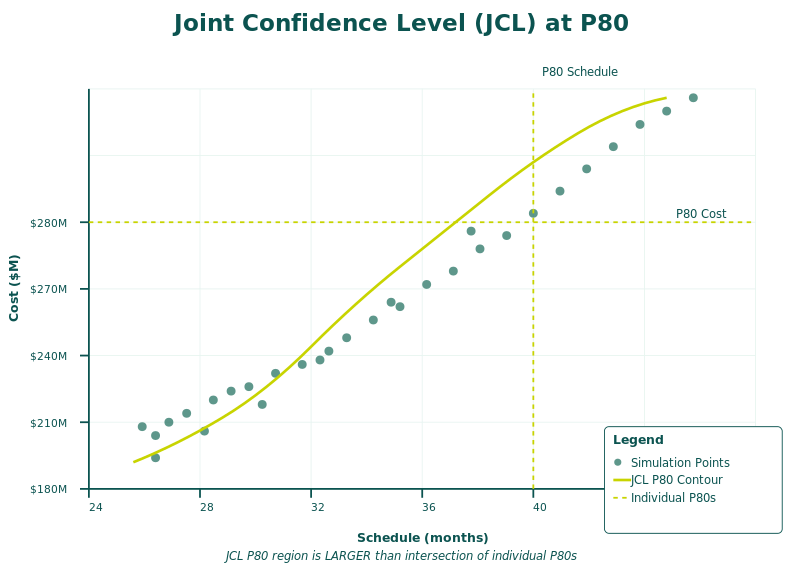
• X-axis: Project completion date for that iteration
• Y-axis: Total project cost for that iteration
The scatter plot is divided into four quadrants by two lines: the target completion date (vertical) and the target budget (horizontal).
| Quadrant | Position | Meaning |
|---|---|---|
| Q1: Success Zone | Bottom-Left | On budget AND on schedule. The percentage of dots here IS the JCL. |
| Q2: Late but Under Budget | Bottom-Right | Schedule risk materialized, cost risk did not. |
| Q3: Over Budget but On Time | Top-Left | Cost risk materialized, schedule risk did not. |
| Q4: Worst Case | Top-Right | Both risks materialized. Over budget AND late. |
Reading the JCL Number
Count the percentage of simulation dots falling in Q1 (bottom-left). That percentage is the Joint Confidence Level.
Example from an IQRM infrastructure project review: A Middle East infrastructure program showed individual schedule P80 of December 2027, individual cost P80 of $620 million, but JCL with both targets of only 52%. This means only 52% of simulation iterations achieved both the deadline and the budget. The board had been reporting "P80 confidence" based on the individual analyses. The integrated analysis revealed the true confidence was barely above a coin flip.
To reach an 80% JCL, the project needed either an additional 4 months of schedule buffer, an additional $45 million of cost contingency, or a combination of both.
How to Build the ICSRA Model
Step 1: Complete the Schedule Risk Model (QSRA)
Build the full schedule risk model with all risk variables: estimated uncertainties on activity durations, discrete risk events, correlation between related risks, and calendar risks. This model must be validated before integration. See IQRM's guide on Schedule Risk Analysis (QSRA) for the complete methodology.
Step 2: Classify Cost Elements
Go through the project cost estimate and classify every line item:
• Fixed cost: Apply cost uncertainty as a continuous distribution (e.g., material cost is Triangle: $10M / $12M / $15M)
• Time-dependent cost: Link to a hammock activity that spans the project duration (or relevant phase). Apply the monthly burn rate so cost scales with duration.
• Discrete cost risk: Apply as a probabilistic event with cost impact (e.g., 25% chance of a $3M to $5M remediation cost)
Step 3: Create Hammock Activities
Hammock activities are schedule activities that automatically extend based on the duration of the activities they span. They are the mechanism that links schedule delays to cost increases.
Example: Create a hammock called "Construction Indirect Costs" that spans from construction start to construction finish. Assign a cost rate of $5 million per month. When the Monte Carlo simulation delays the construction finish by 2 months, the hammock extends by 2 months, adding $10 million to the total cost for that iteration.
In Safran Risk, hammock activities are configured to follow the start and finish of specified milestone activities. Multiple hammocks can represent different indirect cost categories (construction management, equipment rental, site facilities).
Step 4: Apply Cost Uncertainties
For each cost element, apply the appropriate distribution:
• Material costs: Triangle or PERT based on supplier quotes vs. estimate
• Equipment: Triangle with range reflecting procurement market conditions
• Subcontracts: Triangle based on tender spread
• Indirect costs: Uncertainty on the burn rate itself (the rate per month may vary)
Step 5: Run the Integrated Simulation
Configure the Monte Carlo engine to track both schedule completion date and total cost for each iteration. Run a minimum of 5,000 iterations (10,000 preferred).
Step 6: Generate and Interpret the JCL
Plot the scatter diagram with date on the x-axis and cost on the y-axis. Draw the target lines. Count the percentage of dots in Q1.
Present the results as: "The project has a [X]% probability of achieving both the [date] deadline and the [$Y] budget simultaneously."
Common JCL Findings That Surprise Executives
Finding 1: JCL is always lower than individual P-values. This surprises nearly every executive the first time they see it. If they approved contingency based on individual P80 values, they approved less contingency than needed for 80% joint confidence.
Finding 2: Time-dependent costs are the largest cost risk driver. On most EPC projects, the largest single cost risk is not a specific technical risk or procurement risk. It is the prolongation of indirect costs caused by schedule delays. This is invisible in a cost-only QCRA.
Finding 3: Schedule mitigation has a double benefit. Reducing schedule risk not only improves the schedule P-values but also reduces cost risk by shortening the period over which indirect costs accumulate. This "double dividend" makes schedule-focused mitigation the highest-ROI investment on most projects.
Finding 4: The scatter plot shape reveals the risk profile. If the scatter cloud is elongated along the x-axis (wide date range, narrow cost range), schedule risk dominates. If elongated along the y-axis, cost risk dominates. If roughly circular, both dimensions contribute equally. This shape immediately tells you where to focus mitigation.
Frequently Asked Questions
What is Joint Confidence Level (JCL)?
JCL is the probability of a project achieving both its cost target and schedule target simultaneously. It is calculated from an Integrated Cost and Schedule Risk Analysis (ICSRA), where Monte Carlo simulation produces paired cost-date outcomes for each iteration. The percentage of iterations that fall within both targets is the JCL.
Why is JCL always lower than individual P-values?
Because achieving two targets simultaneously is harder than achieving either one alone. Even if each target individually has 80% confidence, the combined probability is lower because the same risk events can cause both schedule delays and cost overruns. The positive correlation between time and cost further reduces the joint probability.
What data do I need for ICSRA that I do not need for QSRA alone?
You need the project cost estimate broken down into fixed and time-dependent categories, monthly indirect cost burn rates for each project phase, and cost uncertainty distributions for each cost element. The schedule model, risk register, and correlation structure are the same as a standalone QSRA.
What tools support ICSRA and JCL?
Safran Risk is the primary tool for integrated analysis in Oil & Gas and EPC, with native support for hammock activities, cost loading, and JCL scatter plots. Argo Monte Carlo also supports integrated models. Both import directly from Primavera P6.
How do I improve a low JCL?
Focus mitigation on schedule risk first, because schedule delays drive both date overrun and cost overrun through indirect cost prolongation. The "double dividend" of schedule mitigation (improving both dimensions simultaneously) typically offers the best ROI. Then address standalone cost risks that do not have a schedule component.
Is JCL used in practice?
Increasingly, yes. Major operators in the GCC (Saudi Aramco, ADNOC) and in the UK/North Sea are requiring JCL analysis for major project approvals. The AACEI and GAO have published guidance recommending integrated cost-schedule risk analysis for large programs. JCL is becoming a standard requirement for FID (Final Investment Decision) submissions on capital projects above $500 million.
Take the next step. If your organization reports schedule confidence and cost confidence as separate numbers, your executives are making decisions based on an incomplete picture. IQRM's QRM Professional Diploma teaches the complete ICSRA methodology: from building the integrated model to generating JCL scatter plots and presenting the results in a way that drives honest contingency decisions.
IQRM is a specialist institute for Quantitative Risk Management, delivering Quantitative Schedule Risk Analysis (QSRA), Quantitative Cost Risk Analysis (QCRA) and Monte Carlo simulation training and consulting to major capital projects across the United Kingdom, Saudi Arabia and the UAE.
QRM Training
Consulting
Knowledge Hub
QSRA on UK Major Projects
United Kingdom
QSRA & QCRA training and consulting for UK infrastructure, nuclear and energy programmes.
QSRA Training UK
info@iqrm.net
United Arab Emirates
Rolex Tower, Sheikh Zayed Road, Dubai
+971 50 362 5784
QSRA Training UAE
Saudi Arabia
Riyadh delivery for giga-projects and Vision 2030 programmes.
QSRA Training Saudi Arabia
info@iqrm.net