
Most project schedules include a contingency buffer, but few project teams can explain where the number came from. A 10% buffer on a 24-month pipeline project means something very different from 10% on a 6-month software rollout, yet the logic behind both is often identical: somebody picked a round number that felt about right. That approach fails every governance review that asks "why this number?"
A schedule contingency reserve is a data-driven time buffer added to a project schedule based on Monte Carlo simulation results. It replaces arbitrary percentage-based buffers with a defensible range derived from QSRA S-curves and confidence levels like P50, P80, and P90, giving project teams a quantified basis for setting realistic completion dates.
When you size your schedule contingency using quantitative schedule risk analysis, you move from a position you cannot defend in a governance review to one backed by a probability distribution that maps every plausible outcome your project could face. The difference is not academic. It directly determines whether a project board approves your timeline or sends you back to replan.
This guide walks through the complete process of sizing a schedule contingency reserve using quantitative risk analysis, from reading S-curves to selecting the right confidence level for your project context.
Why Percentage-Based Schedule Buffers Fail
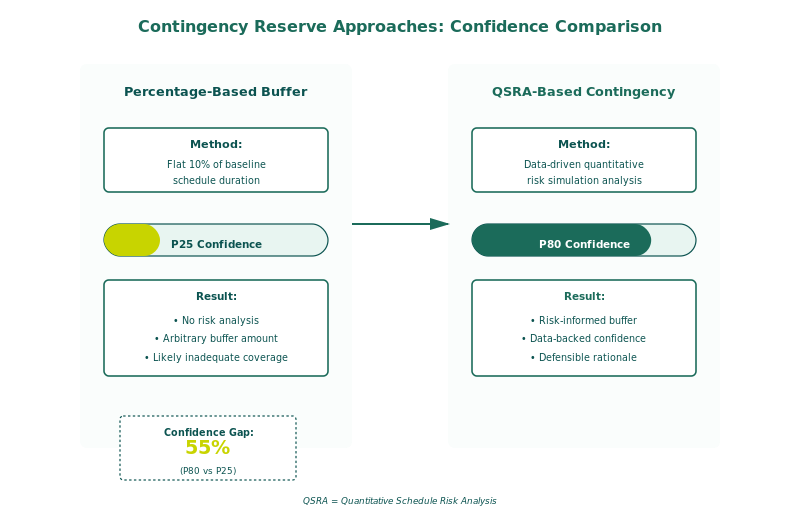
Percentage-based schedule buffers fail because they ignore the project’s actual risk profile, treating all schedules as equally uncertain regardless of complexity, critical path logic, or known threats.
First, a flat percentage ignores the risk profile. A brownfield turnaround shutdown with 200 parallel activities and weather exposure carries fundamentally different uncertainty than a greenfield fabrication yard with a sequential logic. Applying 10% to both produces a contingency that is simultaneously too large for one and dangerously small for the other.
Second, it provides no traceability. When a project director asks which risks the buffer covers and how much each contributes, a percentage-based number has no answer. There is no audit trail connecting the buffer to specific threats, which makes it impossible to defend in a Front End Loading (FEL) gate review or sanction decision.
Third, it cannot be updated. As risks are mitigated or new threats emerge, a percentage buffer stays static. A QSRA-derived contingency, by contrast, can be re-run after each risk response cycle to show exactly how much the reserve has changed and why. IQRM recommends re-running the model at every major project milestone to keep the contingency aligned with the live risk register.
How QSRA Produces a Data-Driven Schedule Contingency
QSRA (Quantitative Schedule Risk Analysis) produces a schedule contingency by running thousands of Monte Carlo simulation iterations against a logic-linked project schedule, generating an S-curve that shows every possible completion date and its probability.
The process is straightforward: the deterministic schedule (single-point estimate) is loaded into a tool like Safran Risk. Duration uncertainties (three-point estimates) and discrete risk events are mapped to activities. The simulation runs 5,000–10,000 iterations, each time sampling from the assigned probability distributions. The output is a cumulative distribution function (S-curve) plotting finish dates against confidence levels.
Schedule Contingency Reserve = P[Target] Finish Date − Deterministic Finish Date
If the deterministic schedule shows a completion date of 1 March 2027 and the P80 result from Monte Carlo is 15 June 2027, the schedule contingency reserve is 106 days (approximately 3.5 months). That number is traceable, defensible, and directly linked to the risks modeled in the simulation. For a full walkthrough of the seven QSRA phases, see Schedule Risk Analysis (QSRA): Guide to Monte Carlo + Examples.
Reading the S-Curve to Set Your Schedule Buffer
The S-curve is the single most important output of a QSRA, and reading it correctly is the difference between a defensible contingency and a guess dressed up as analysis.
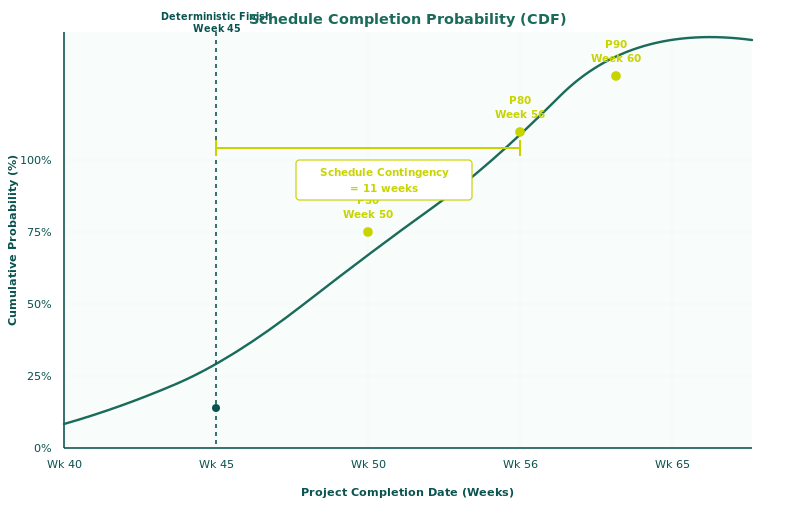
Step 1 — Locate Your Deterministic Finish Date on the S-Curve
The deterministic date is the finish date from the unrisked schedule. On the S-curve, it typically falls between P5 and P20, which means the project has only a 5–20% chance of finishing on or before the planned date. IQRM’s project experience across oil and gas, EPC, and infrastructure consistently shows deterministic dates landing at P10–P15 for well-planned schedules. If yours falls above P30, the schedule likely contains excessive float or has not been properly health-checked. Before running the simulation, confirm your schedule passes all five critical checks in Schedule Quality for Risk Analysis: The Health Checks That Make or Break Your Model.
Step 2 — Identify the Target Confidence Level
The confidence level defines how much risk your organization is willing to absorb. P50 means a 50% chance of finishing on or before that date. P80 means 80%. P90 means 90%. The higher the confidence level, the larger the contingency. IQRM recommends P80 as the default for most capital projects because it balances risk exposure against excessive conservatism. P90 is appropriate for safety-critical milestones or contractual penalties. P50 is the median outcome and is commonly used for internal planning targets, but it should never be presented as a commitment date because the project has a coin-flip chance of overrunning it.
Step 3 — Calculate the Gap
Subtract the deterministic finish date from the P-target date. The difference, expressed in working days or calendar weeks, is the schedule contingency reserve. Present this to stakeholders alongside the S-curve itself, so they can see the full distribution and understand what the buffer covers.
Choosing the Right Confidence Level — P50 vs P80 vs P90
The confidence level you select determines the size of your schedule contingency reserve, and IQRM recommends choosing it based on the decision context, not a blanket policy.
| Confidence Level | What It Means | Typical Use Case | Contingency Size |
|---|---|---|---|
| P50 | 50% chance of finishing on or before this date | Internal planning target, portfolio-level forecasting | Moderate (median outcome) |
| P80 | 80% chance of finishing on or before this date | Sanction decisions, FEL gate reviews, client commitments | Recommended default for most capital projects |
| P90 | 90% chance of finishing on or before this date | Safety-critical milestones, liquidated damages clauses, regulatory deadlines | Conservative (upper range) |
The gap between P50 and P80 is often where the governance conversation happens. A project director who sees the S-curve can make an informed trade-off: accept more risk at P50 to save budget, or invest in a larger buffer at P80 for a higher likelihood of delivery. Without the S-curve, that conversation is impossible. According to IQRM’s consulting experience on GCC mega-projects, the P50-to-P80 gap typically ranges from 8% to 18% of the total project duration, depending on the risk profile and correlation structure.
What the Tornado Chart Tells You About Your Contingency
The tornado chart from your QSRA sensitivity analysis identifies which risks and activities contribute the most days of delay to the schedule contingency reserve.
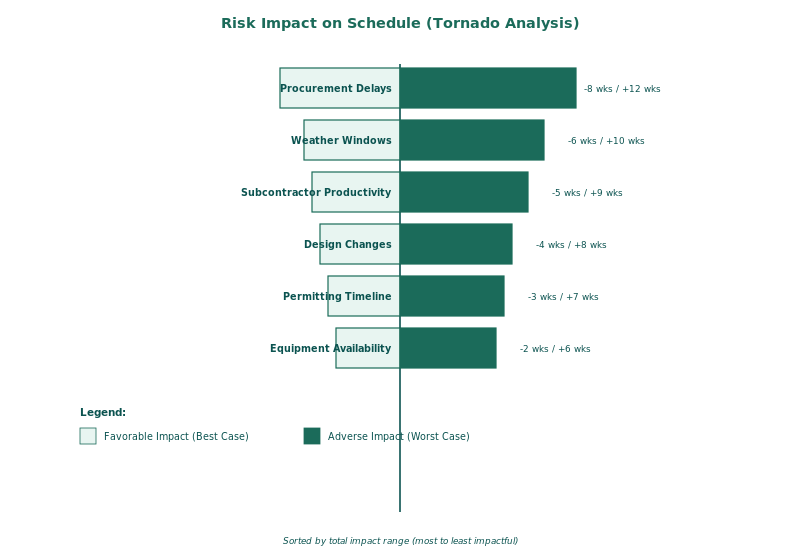
The top 5–10 risk drivers typically account for 60–80% of total schedule variance. This means your mitigation effort should concentrate on a small number of high-impact items rather than spread thinly across dozens of minor risks. For a detailed guide on reading tornado charts and translating them into prioritized mitigation actions, see Sensitivity Analysis in Schedule Risk: Tornado Charts & Risk Drivers.
After mitigation, re-run the simulation to produce a post-mitigation S-curve. The shift between pre-mitigation and post-mitigation P80 dates quantifies the return on investment for each risk response. This comparison is covered in detail in Pre-Mitigation vs Post-Mitigation Risk Analysis: How to Measure What Your Response Plan Is Worth.
Best Practices for Defending Your Schedule Contingency Reserve
A data-driven schedule contingency reserve is only as strong as your ability to communicate it to decision-makers.
Present the S-curve, not just the number. Showing a single date without context invites challenge. The S-curve lets stakeholders see the full distribution, the deterministic date’s position, and the probability of meeting different target dates. According to IQRM’s training methodology, executives respond to visual evidence of risk spread far more readily than to tabular data alone.
Connect the contingency to specific risk drivers. Use the tornado chart to show which five risks contribute the most days of delay. This makes the contingency tangible: “42 of these 106 contingency days come from procurement lead time uncertainty and weather downtime during the marine installation window.”
Show the pre-mitigation and post-mitigation comparison. This demonstrates that the contingency is not a slush fund. It is the residual uncertainty after active risk management has already reduced the exposure. If mitigation brings P80 from 15 June to 28 April, you can show exactly what the risk response plan is worth in schedule terms.
Re-run the model at every major milestone. The contingency should shrink as risks are retired and grow if new threats emerge. A live, updated QSRA model keeps the reserve honest and prevents it from becoming a static number that nobody trusts. IQRM recommends tying re-runs to FEL gate reviews and quarterly risk register updates.
Frequently Asked Questions
What is a schedule contingency reserve?
A schedule contingency reserve is a time buffer added to a project schedule to account for identified risks and uncertainties. It is sized using quantitative risk analysis methods like Monte Carlo simulation, which produce a defensible range of possible completion dates at defined confidence levels.
How do you calculate schedule contingency using Monte Carlo simulation?
Run a Monte Carlo simulation on your logic-linked schedule with duration uncertainties and discrete risk events mapped to activities. The schedule contingency equals the difference between your target confidence level date (such as P80) and the deterministic finish date from the unrisked schedule.
What confidence level should you use for schedule contingency?
IQRM recommends P80 as the default confidence level for most capital project schedule contingency reserves. P80 provides an 80% probability of finishing on or before the target date, balancing risk exposure against excessive conservatism. P90 is appropriate for safety-critical or contractually penalized milestones.
What is the difference between schedule contingency reserve and management reserve?
Schedule contingency reserve covers identified risks with quantified probability and impact. Management reserve covers unknown risks that cannot be anticipated or modeled. Contingency is managed by the project manager; management reserve is held by the project sponsor or executive and released through a formal change process.
Why is a percentage-based schedule contingency unreliable?
Percentage-based buffers ignore the project’s actual risk profile, provide no traceability to specific threats, and cannot be updated as risks change. A 10% buffer applied uniformly treats all projects as equally uncertain, which produces contingencies that are simultaneously too large for low-risk work and too small for high-risk programmes.
How does QSRA improve schedule contingency sizing?
QSRA replaces guesswork with Monte Carlo simulation that models thousands of possible outcomes based on mapped risks and duration uncertainties. The output is an S-curve showing the probability of finishing by any given date, giving decision-makers a defensible, traceable basis for the contingency rather than an arbitrary percentage.
IQRM delivers specialist training and consulting in schedule risk analysis, Monte Carlo simulation, and risk-based forecasting. Our QRM Diploma programme equips professionals with the practical skills to build, run, and interpret QSRA models on real projects.
Written by Rami Salem, Quantitative Risk Management specialist with over 15 years of experience across oil and gas, EPC/EPCM, and infrastructure projects.
IQRM is a specialist institute for Quantitative Risk Management, delivering Quantitative Schedule Risk Analysis (QSRA), Quantitative Cost Risk Analysis (QCRA) and Monte Carlo simulation training and consulting to major capital projects across the United Kingdom, Saudi Arabia and the UAE.
QRM Training
Consulting
Knowledge Hub
QSRA on UK Major Projects
United Kingdom
QSRA & QCRA training and consulting for UK infrastructure, nuclear and energy programmes.
QSRA Training UK
rs@iqrm.net
United Arab Emirates
Rolex Tower, Sheikh Zayed Road, Dubai
+971 50 362 5784
QSRA Training UAE
Saudi Arabia
Riyadh delivery for giga-projects and Vision 2030 programmes.
QSRA Training Saudi Arabia
rs@iqrm.net