
Written by Rami Salem, Quantitative Risk Management Specialist
Most schedule contingency reserves are a guess dressed up as a plan. A project director asks for a buffer, and someone adds 10% to the baseline. No analysis. No data. No defensibility. When the board challenges that number, the only answer is "industry practice," which really means "we made it up."
There is a better way. Quantitative Schedule Risk Analysis (QSRA) uses Monte Carlo simulation to model how uncertainty and specific risk events affect your project timeline, producing a probability distribution of finish dates. The difference between your deterministic plan and the date at your chosen confidence level (P50, P80, or P90) is your schedule contingency reserve. It is traceable, defensible, and sized to the actual risk profile of your project.
Schedule contingency reserve is a planned time buffer sized through quantitative risk analysis to absorb identified risks and estimation uncertainty. It replaces arbitrary percentage padding with Monte Carlo simulation, producing confidence-based finish dates (P50, P80, P90). This gives decision-makers a defensible basis for committing to milestones instead of relying on gut feel or unsubstantiated industry benchmarks.
What Is a Schedule Contingency Reserve?
A schedule contingency reserve is a planned time allocation, built into the project timeline, to absorb the impact of identified risks and inherent estimation uncertainty. It is not float. It is not management reserve. It is not padding.
Here is the distinction that matters:
Schedule contingency reserve addresses known risks (identified in the risk register) and the natural uncertainty in activity duration estimates. It sits within the project baseline and is controlled by the project manager.
Management reserve covers unknown unknowns, events that were not identified during risk assessment. It sits outside the baseline and requires senior management approval to access.
Float (slack) is a scheduling calculation, the time an activity can slip without delaying a successor or milestone. Float is not a reserve. It is a mathematical byproduct of the network logic, not a deliberate provision for risk.
The problem is that many organizations confuse these three concepts, or worse, treat float as their contingency. When float gets consumed by normal schedule variation, there is nothing left to absorb a real risk event.
Key insight: Float is found. Contingency is sized. Management reserve is held. Each serves a different purpose and is governed differently.
Why Percentage-Based Contingency Fails
The most common method for setting schedule contingency is a percentage add-on: take the deterministic schedule duration and add 5%, 10%, or 15%. It is simple, fast, and wrong for any project where the stakes justify doing it properly.
Here is why it fails:
It ignores the actual risk profile. A 10% buffer on a low-risk office fit-out and a 10% buffer on a brownfield turnaround are not equivalent. The risk profiles are completely different, yet the method treats them identically.
It does not identify what drives the delay. A percentage tells you nothing about which risks or activities contribute most to potential overrun. Without that information, you cannot prioritize mitigation spend.
It is indefensible under scrutiny. When a client, regulator, or investment committee asks "Why 10% and not 8%?" there is no answer grounded in evidence. The number is arbitrary.
It creates false confidence. Stakeholders see a contingency line item and assume the schedule is protected. But a flat percentage may be too much for some paths and far too little for others, depending on where the real risk concentrations sit.
IQRM's project experience across Oil and Gas, EPC, and infrastructure mega-projects consistently shows that percentage-based contingency either oversizes (wasting capital) or undersizes (exposing the project to liquidated damages and reputational harm). The cost of getting it wrong dwarfs the cost of running a proper analysis.
How QSRA Sizes Schedule Contingency: The Step-by-Step Process
Quantitative Schedule Risk Analysis replaces guesswork with a structured, data-driven process. Here is how it works, following IQRM's 7-phase methodology:
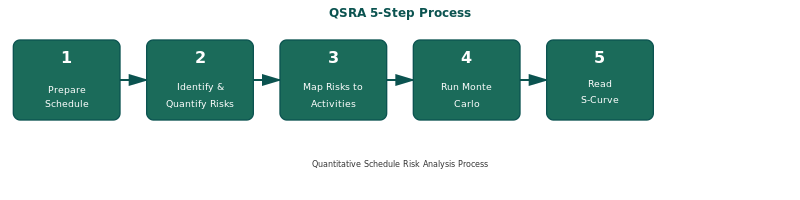
Step 1: Prepare the Schedule
Import your Primavera P6 or Microsoft Project schedule into a QSRA tool such as Safran Risk. Then run a schedule health check. This is non-negotiable. A QSRA model built on a broken schedule produces meaningless contingency numbers.
The health check targets:
- Hard constraints (Must Finish On, Must Start On) that lock dates and prevent the simulation from showing realistic variation
- Open-ended activities missing predecessors or successors, which break the critical path logic
- Long lags and leads that should be converted to dummy activities so uncertainty can be applied
- Excessive SS/FF relationships that create hammock behavior, making activities jiggle without clear start/end dependencies
Step 2: Identify and Quantify Risks
Build the risk register with two categories of variables:
Estimated uncertainties (Business as Usual): These are always present (100% probability) and represent the natural range in how long an activity might take. Modeled as min/most likely/max ranges using distributions like BetaPERT or Triangular. Limited to one per activity.
Discrete risk events: Specific threats or opportunities that may or may not occur. Each has a probability below 100% and an impact range if it does occur. Modeled using Bernoulli or Binomial distributions.
IQRM recommends grounding both categories in the Risk Data Engine (RDE): historical data from past projects, supplier performance records, weather time-series, and incident logs. For a detailed walkthrough of building a quantitative risk register that feeds into this process, see IQRM's dedicated guide. Where data exists, fit distributions statistically. Where it does not, use structured expert elicitation, but challenge optimism bias explicitly.
Step 3: Map Risks to Activities
Link each risk event and duration uncertainty to the specific schedule activities it affects. Define whether impacts operate in series (delays stack) or parallel (delays overlap; only the longest one drives the finish).
Add correlations where risks share common drivers. If your piping contractor performs poorly on one scope area, they are likely to perform poorly on another. A positive correlation of 0.6 to 0.8 is typical for shared contractor performance. Without correlation, the model underestimates the tail risk, and your contingency will be too small.
Step 4: Run Monte Carlo Simulation
Configure and execute the simulation:
- Iterations: 5,000 to 10,000 for stable tail percentiles
- Random seed: Lock at a fixed value for reproducible results across review cycles
- Convergence: Enable auto-stop once P80 stabilizes within 3% tolerance
- Sampling: Use Latin Hypercube Sampling (LHS) for efficient coverage on large models
Step 5: Read the Contingency from the S-Curve
The simulation produces a cumulative distribution function (S-curve) of finish dates. Your schedule contingency reserve is the gap between the deterministic finish date and the date at your chosen confidence level.
Formula:
Schedule Contingency = P-date (at chosen confidence level) minus Deterministic Finish Date
For example, if your deterministic finish is 1 June 2027 and the P80 date is 15 August 2027, your schedule contingency reserve is 75 days. That number is not a guess. It is derived from thousands of simulated scenarios reflecting the specific risks mapped to your specific schedule.
Step 6: Identify the Risk Drivers
The tornado chart ranks which risks and activities contribute most to the contingency. This is the action list. If the top three drivers account for 60% of the delay, that is where mitigation investment should go.
Run a post-mitigation scenario after applying proposed control measures. Compare the pre- and post-mitigation S-curves to calculate the return on investment: "Spending $400K on air freight for critical valves moves P80 from 75 days to 56 days of contingency, saving 19 days and avoiding $2.1M in liquidated damages."
P50, P80, or P90: Choosing the Right Confidence Level
The confidence level you choose directly determines the size of your contingency reserve. There is no universally correct answer; it depends on your organization's risk tolerance and contractual obligations.
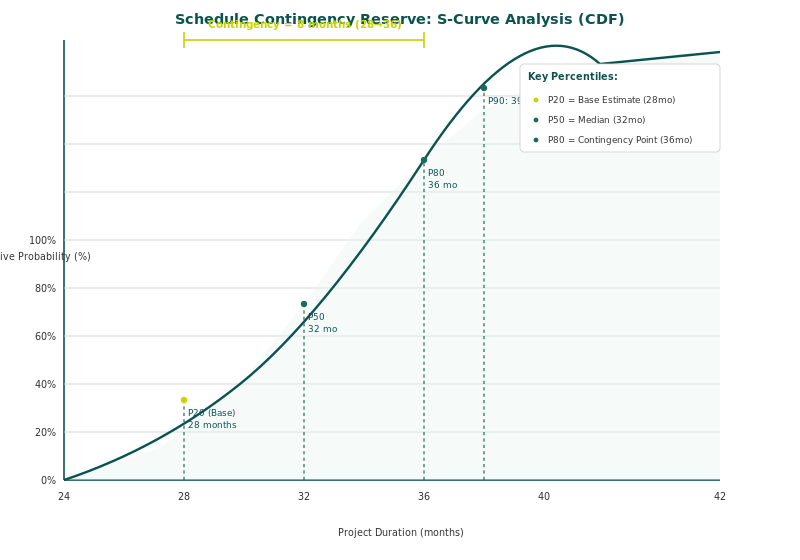
P50 (50th percentile): The median outcome. Half the simulated scenarios finish earlier, half finish later. IQRM considers P50 appropriate for internal planning targets but too aggressive for external commitments. You are essentially saying "we have a coin-flip chance of making this date."
P80 (80th percentile): The most commonly used confidence level for schedule commitment and contingency sizing in IQRM's experience. It means 8 out of 10 simulated scenarios finish on or before this date. P80 balances protection against likely risks with reasonable capital allocation. According to IQRM's project data, the deterministic schedule typically falls between P5 and P20, meaning the planned finish date has only a 5-20% chance of being met without contingency.
P90 (90th percentile): Conservative. Used for safety-critical milestones, regulatory deadlines, or projects with severe liquidated damages clauses. The trade-off: P90 contingency is significantly larger and ties up more capital.
IQRM's recommended practice: Plan at P50 for internal tracking. Commit at P80 for stakeholder and contractual milestones. Reserve P90 for safety-critical or penalty-heavy commitments. Document the rationale for the chosen P-value in the risk report.
Real-World Example: Sizing Contingency on an Offshore EPC Project
Consider a 24-month offshore platform modification project. The deterministic schedule shows a completion date of March 2028.
After running QSRA with Safran Risk:
| Confidence Level | Finish Date | Contingency (vs. Deterministic) |
|---|---|---|
| P10 (very optimistic) | January 2028 | -2 months (ahead of plan) |
| P50 (median) | June 2028 | +3 months |
| P80 (recommended) | September 2028 | +6 months |
| P90 (conservative) | November 2028 | +8 months |
The tornado chart shows the top three drivers:
- Fabrication yard productivity uncertainty (contributing 31% of total delay)
- Weather downtime during heavy lift window (contributing 22%)
- Long-lead equipment procurement delays (contributing 15%)
Armed with this data, the project team can make targeted decisions: invest in weather monitoring and pull-ahead strategies for the heavy lift, negotiate penalty clauses with the fabrication yard, and approve air freight for the critical long-lead items. Each decision has a quantified impact on the contingency reserve.
This is the difference between "we added 6 months because it felt right" and "the model shows 6 months at P80, driven primarily by three quantifiable risk factors, each with a defined mitigation path."
The IQRM Framework for Defensible Schedule Contingency
IQRM's approach to schedule contingency sizing follows five principles:
1. Data before opinion. Use the Risk Data Engine (RDE) to ground duration ranges and risk probabilities in historical evidence. Fit distributions to data where it exists. Challenge expert estimates where it does not.
2. Model what is real. Use calendar risks for seasonal weather impacts (monsoon windows, sandstorm seasons) rather than inflating duration ranges. Model correlation between related activities and risks. Include both uncertainties and discrete events.
3. Size to a stated confidence level. The contingency number must always be reported alongside the P-value it represents. "6 months at P80" is meaningful. "6 months" without context is not.
4. Show the drivers. Every contingency recommendation must include the tornado chart showing what is driving the number. Without drivers, stakeholders cannot make informed mitigation decisions.
5. Update continuously. Schedule contingency is not a one-time calculation. IQRM recommends re-running the QSRA quarterly (or at major phase gates) and trending the P-dates over time. A contingency reserve that was right at sanction may be wrong 12 months later as risks materialize or retire.
Frequently Asked Questions
What is a schedule contingency reserve in project management?
A schedule contingency reserve is a planned time buffer within the project baseline to absorb the impact of identified risks and estimation uncertainty. Unlike float, which is a natural byproduct of schedule network logic, contingency is deliberately sized using risk analysis. IQRM recommends deriving it from QSRA using the gap between the deterministic plan and the P80 date.
How do you calculate schedule contingency using Monte Carlo simulation?
Run a Quantitative Schedule Risk Analysis (QSRA) by mapping duration uncertainties and discrete risk events to schedule activities, then executing 5,000 to 10,000 Monte Carlo iterations. The resulting S-curve shows finish dates at each confidence level. Schedule contingency equals P-date minus deterministic finish date at your chosen confidence level (typically P80).
What is the difference between schedule contingency and float?
Float (slack) is the calculated time an activity can slip without delaying a successor or project milestone. It is a mathematical result of schedule logic, not a provision for risk. Schedule contingency is a deliberate buffer sized through risk analysis to absorb identified risks. Float can be consumed by normal variation; contingency is governed and drawn down against specific risk events.
Should I use P50, P80, or P90 for my schedule contingency?
It depends on your risk tolerance and contractual exposure. IQRM recommends P50 for internal planning targets, P80 for stakeholder commitments and contingency sizing (the most common standard), and P90 for safety-critical or penalty-heavy milestones. Always document which P-value you are using and why.
Why is a 10% schedule contingency often wrong?
A flat percentage ignores the project's actual risk profile. Two projects of the same duration can have vastly different risk exposures depending on complexity, location, contractor capability, and supply chain dependencies. Percentage-based contingency cannot identify risk drivers or justify the number under scrutiny. QSRA produces a data-driven figure tied to specific, quantified risks.
How often should schedule contingency be recalculated?
IQRM recommends re-running the QSRA at every major phase gate and at minimum quarterly during execution. Risks materialize, new risks emerge, and durations are updated as actuals replace estimates. A contingency reserve calculated at project sanction will not reflect reality 12 months later without refreshing the model.
What tools can I use for schedule contingency analysis?
Safran Risk is the industry standard for QSRA, supporting schedule import from Primavera P6 and Microsoft Project, risk mapping, correlation modeling, convergence, and comprehensive reporting. Primavera Risk Analysis (Pertmaster) is another enterprise option. For simpler models or learning, Excel with Monte Carlo add-ins like Argo or ModelRisk can produce valid results. IQRM's guide to Monte Carlo Simulation in Excel (Step-by-Step) covers the fundamentals.
Ready to learn how to size schedule contingency defensibly? The QRM Diploma (Quantitative Risk Management + AI) teaches the complete QSRA methodology hands-on, from schedule health checks through Monte Carlo simulation to contingency sizing and executive reporting, using Safran Risk on real project data.
IQRM is a specialist institute for Quantitative Risk Management, delivering Quantitative Schedule Risk Analysis (QSRA), Quantitative Cost Risk Analysis (QCRA) and Monte Carlo simulation training and consulting to major capital projects across the United Kingdom, Saudi Arabia and the UAE.
QRM Training
Consulting
Knowledge Hub
QSRA on UK Major Projects
United Kingdom
QSRA & QCRA training and consulting for UK infrastructure, nuclear and energy programmes.
QSRA Training UK
rs@iqrm.net
United Arab Emirates
Rolex Tower, Sheikh Zayed Road, Dubai
+971 50 362 5784
QSRA Training UAE
Saudi Arabia
Riyadh delivery for giga-projects and Vision 2030 programmes.
QSRA Training Saudi Arabia
rs@iqrm.net