QRM Professional Training
Become the Risk Manager who can independently build and defend QSRA and QCRA models.
Build your first QSRA and QCRA model in under four weeks. The full programme unlocks the day you enrol, so you work at your own pace and take a Monte Carlo schedule and cost model from a blank sheet to a number you can defend in the room where the decision gets made. A hands-on QSRA and QCRA programme, built on Safran Risk, for project controls professionals across the UK and GCC.
Sit the first live session. If it is not for you, full refund, no questions.
 the industry-standard risk tool
You have watched a role you could half-do go to someone who could build the QSRA model. Not because they understood risk better than you. Because they could prove it.
"99% of the risk management roles we place in the UK require QSRA capability as a minimum."
That is not a marketing line. It is market data from Chirag Shah, Director of PACE GLOBAL, the UK's leading project controls and risk recruitment firm, the people who see every job specification and fill the positions every week.
Three capabilities now appear on nearly every posting for Risk Manager, Planning Engineer, or Project Controls Lead on a major capital programme. They are not optional lines. They are screening criteria. If you cannot demonstrate them, you do not make the shortlist.
QSRA experience
Quantitative Schedule Risk Analysis, built and defended, not just described.
Monte Carlo simulation
Applied on real project data, not theoretical exposure.
Safran Risk or equivalent
Industry-standard tool competence the sanction process expects.
The question was never whether you need QSRA capability. It is how long you are willing to wait to get it. This programme closes the gap in weeks, not three years on the job.
On a £70,000 salary, QSRA capability is worth £8,400 to £11,200 more. Every year.
Chirag Shah, Director of PACE Global, the UK's leading project controls and risk recruitment firm, puts the QSRA salary premium at 12 to 16%. On a £70,000 base, that is £8,400 to £11,200 more each year, for the rest of your career. The programme is a one-off £499 to £595.
Chirag Shah, Director of PACE Global, on the 12 to 16% QSRA salary premium.
Salary premium per Chirag Shah, Director, PACE Global. Illustrative, based on a £70,000 base salary.
It starts with the data behind the model, where most analyses quietly fall apart.
Most QSRA models are dead before the simulation runs, because the data feeding them was never built to be defended. That is where they fall apart in front of a sanction committee. It is also where we start.
Every defensible analysis begins with the data. The Risk Data Engine™ (RDE™) is IQRM's own method for turning standard project information into the statistical inputs a model actually needs. It structures assumptions, distributions, correlations and traceability so every QSRA and QCRA you build is evidence-based, and so it produces a risk-based forecast you can defend. It is the IQRM intellectual property at the heart of this programme.
This is the backbone of every QSRA and QCRA model you will ever produce. Once it is in place, your Monte Carlo simulation stops being a black box. You can show where every number came from, why you chose each distribution, and how the pieces connect. That is what makes your output something a sanction committee can lean on.
Master the Risk Data Engine™ and the tool becomes a detail. It is the difference between an opinion with a histogram attached and a forecast a sanction committee will sign off.
This is a method training, not a tool training. It is built on and demonstrated in Safran Risk, the industry standard, but what you learn is the method beneath the software. Master that and it carries straight over to Primavera Risk Analysis, Deltek Acumen Fuse, or Excel. No academic detours. No black-box modelling. No certificates without competence.
Taught from the practitioner's chair, not the lecturer's.
These are the methods we use on live capital programmes, not theory written up for a classroom. Tier-1 PMC consultancies in the UK train their teams on them, including people who already run QSRA, because applied practice and a set of training slides are not the same thing. You learn how the work is actually done, where models break, and how the number gets defended in the room.
A method you keep, not buttons you forget.
Most QSRA training teaches you where to click in one piece of software. When the tool changes, or your employer uses a different one, you are back to square one. This trains the method underneath, so it transfers anywhere.
A typical software training
- Teaches which buttons to click in one tool
- Tied to a single piece of software
- You can run a model, but not defend it
- Knowledge expires when the tool updates
- No grounding in the judgement behind the numbers
The IQRM method training
- Teaches the method beneath the software
- Transfers to Safran Risk, Primavera Risk Analysis and Deltek Acumen Fuse
- You build the model and defend the decision
- Skills that outlast any tool version or employer
- Built on 15+ years of real capital-programme practice
99% of the roles require this capability. Be the one who can deliver it.
Sit session one. Not for you? Full refund, no questions. The risk sits with us.
QSRA and QCRA curriculum: five modules across three stages.
Foundation of quantitative thinking
Probability as it applies to project risk, not abstract maths. The reasoning every model rests on.
Building the Risk Data Engine™ (RDE™)
Structure assumptions, distributions, correlations, and traceability so your inputs are defensible from day one.
Building a QCRA model
Quantitative cost risk analysis, built by your own hands on real case-study data.
Building a QSRA and integrated ICSRA model
Schedule risk analysis, then integrated cost and schedule risk and joint confidence level.
Risk-based decision making
Interpret P50, P80, and P90, communicate exposure, and turn output into a recommendation a stakeholder can act on.
Capstone project. You close on an industry case-study dataset, submitting a Schedule Risk Model (QSRA), a Cost Risk Model (QCRA), and a Risk-Aware Decision Report with your recommendation. Real conditions, real deliverables, the kind you can point to in an interview.
And the strongest capstone in each cohort is recognised and featured on the IQRM website.
QSRA S-curves, QCRA distributions and tornado charts you build yourself.
Not slides about risk analysis. The real schedule risk analysis and cost risk analysis deliverables, built by your own hand on case-study data, the same Monte Carlo outputs a sanction committee reads.
A cost risk distribution showing where contingency actually needs to sit, P50 versus P80.
The schedule confidence curve, reading off the P80 finish date you can defend.
Sensitivity ranking that tells you which risks to mitigate first, and which to leave.
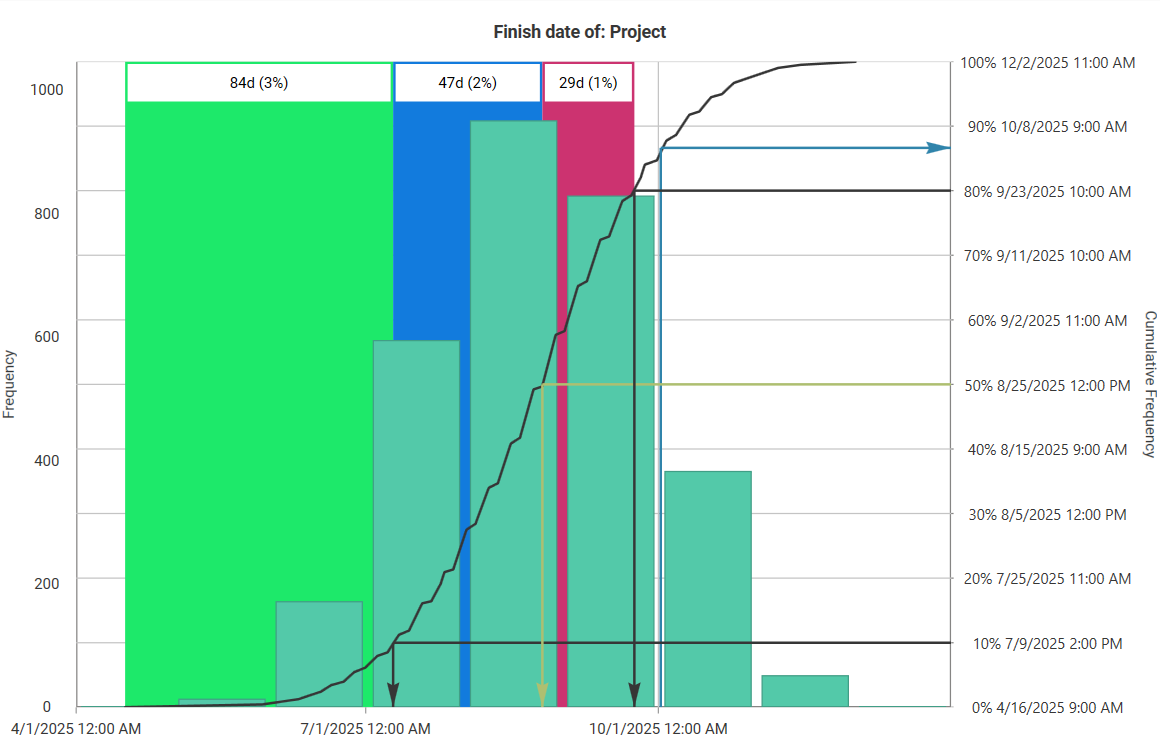
Built on a real-life case study, not a toy dataset.
You do not practise on a sanitised textbook example. You work a full industry case study drawn from real project conditions: a live schedule, real cost data, and genuine uncertainty.
You build your QSRA and QCRA models on it, run the simulation, and defend your recommendation, exactly as you would on a capital programme. It is the difference between understanding the theory and being able to do the job on Monday morning.
Your own model, built by your own hands.
This is not a course you sit and watch. By the end you have produced your own QSRA and QCRA models, run the Monte Carlo simulation, and written the decision report, from a blank sheet to a result you can defend.
Here is what one of our students delivered. Their work, their hands, their model.
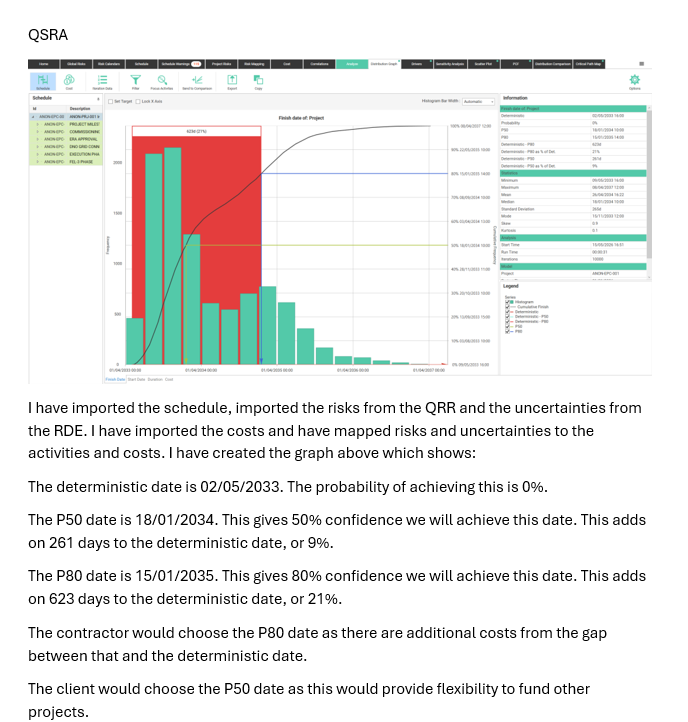
A student's own model, built during the programme.
That could be your model, and your name on the certificate.
Sit session one. Not for you? Full refund, no questions. The risk sits with us.
From analyst to decision partner.
- Build a Risk Data Engine™ that turns project data into traceable, defensible model inputs.
- Independently perform cost risk analysis (QCRA) and schedule risk analysis (QSRA).
- Develop integrated cost and schedule risk (ICSRA) models and joint confidence levels.
- Read percentiles and confidence levels, then turn them into decision-ready insight, not just reports.
- Pass the screening criteria on the roles you actually want next.
This is for you if
- You want hands-on QSRA and QCRA skill, not theory alone
- You work in project controls: planning, cost, schedule, or risk
- You want to run probabilistic analysis independently
- You are aiming for project risk or decision-support roles
This is not for you if
- You want a certificate without doing the modelling
- You are after shortcuts or purely academic exposure
- You will not complete the exercises and capstone
- You expect to passively watch rather than build
200 professionals trained. Now working across major programmes.
Student testimonial · facilitated by Chirag Shah, Director of PACE Global, the UK risk and project controls recruitment firm hiring for QSRA-capable risk managers.
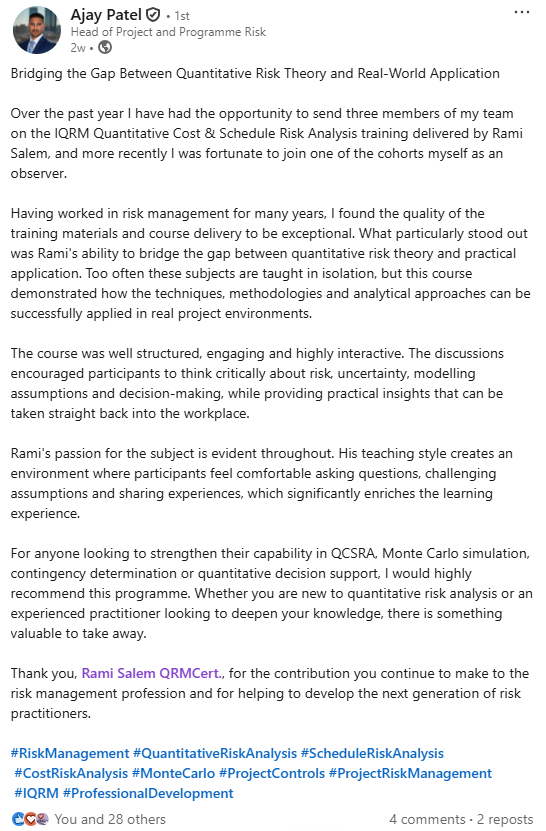
"Over the past year I have had the opportunity to send three members of my team on the IQRM Quantitative Cost & Schedule Risk Analysis training. What particularly stood out was Rami's ability to bridge the gap between quantitative risk theory and practical application."
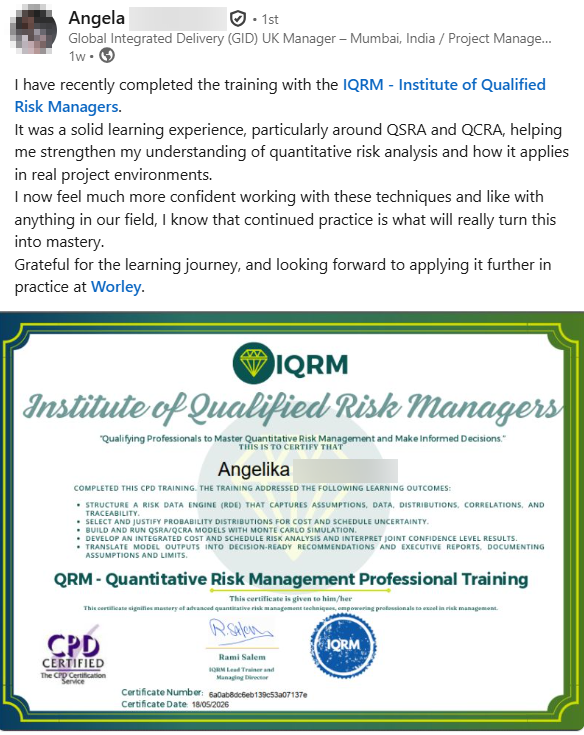
"It was a solid learning experience, particularly around QSRA and QCRA, helping me strengthen my understanding of quantitative risk analysis and how it applies in real project environments. I now feel much more confident working with these techniques."
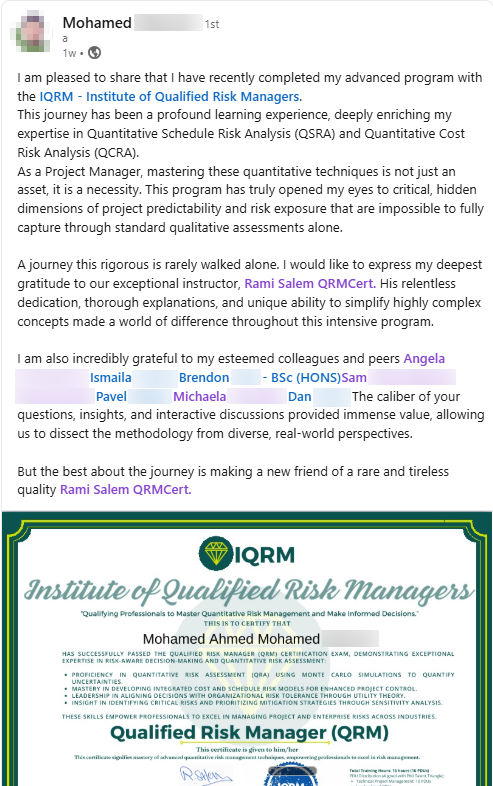
"This program has truly opened my eyes to critical, hidden dimensions of project predictability and risk exposure that are impossible to fully capture through standard qualitative assessments alone. My deepest gratitude to our exceptional instructor, Rami Salem QRMCert."
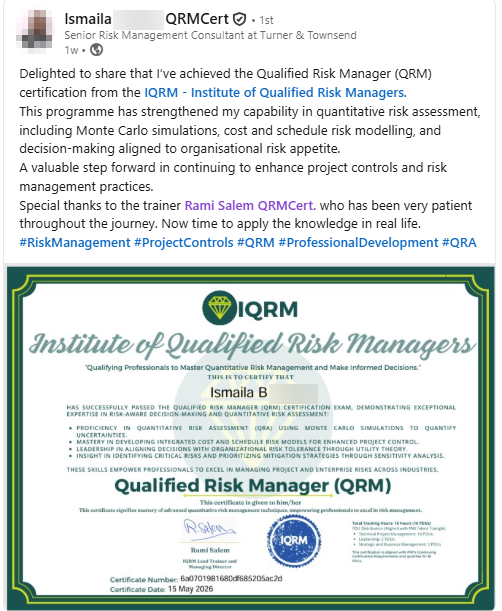
"This programme has strengthened my capability in quantitative risk assessment, including Monte Carlo simulations, cost and schedule risk modelling, and decision-making aligned to organisational risk appetite. A valuable step forward in project controls and risk management practices."
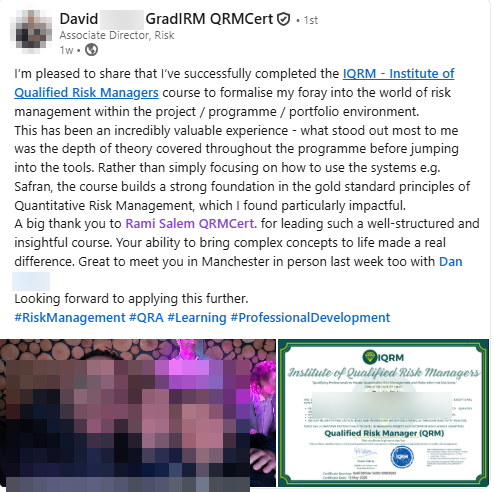
"What stood out most was the depth of theory covered before jumping into the tools. Rather than simply focusing on how to use the systems, the course builds a strong foundation in the gold standard principles of Quantitative Risk Management, which I found particularly impactful."
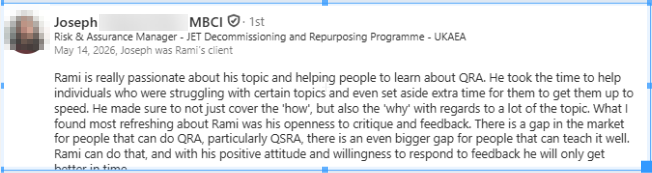
"There is a gap in the market for people that can do QRA, particularly QSRA, and an even bigger gap for people that can teach it well. Rami can do that. He covered not just the 'how' but the 'why', and set aside extra time for anyone struggling."
Verified on LinkedIn
 Approved Saudi Aramco vendor
ADNOC approved consultant
CPD certified training
Built on Safran Risk
Event sponsor · Control, the Skills Authority
Approved Saudi Aramco vendor
ADNOC approved consultant
CPD certified training
Built on Safran Risk
Event sponsor · Control, the Skills Authority
From the far west to the far east.
We train and certify risk professionals across the UK and the GCC, and out to major capital programmes worldwide. Wherever quantitative risk decisions are made, IQRM-trained practitioners are making them.
Eligible UK graduates introduced to PACE Global for placement.
QSRA capability gets you past the shortlist. We go one step further. Through our partnership with PACE Global, the UK's leading project controls and risk recruitment firm, eligible UK graduates of the programme are introduced to PACE for placement into Risk Management roles that require QSRA, exactly the roles their own data shows 99% of UK employers are screening for.
Introductions are subject to eligibility and PACE Global's selection process.
He added the certificate to his profile. The offers came in.
Imran completed the programme, earned his QRMCert., and updated his profile. What happened next is the whole point of this training, in his own words.
Imran, QRM graduate, on the multiple job offers that followed his QRMCert.
Become the QSRA-capable hire 99% of employers are searching for.
Sit session one. Not for you? Full refund, no questions. The risk sits with us.
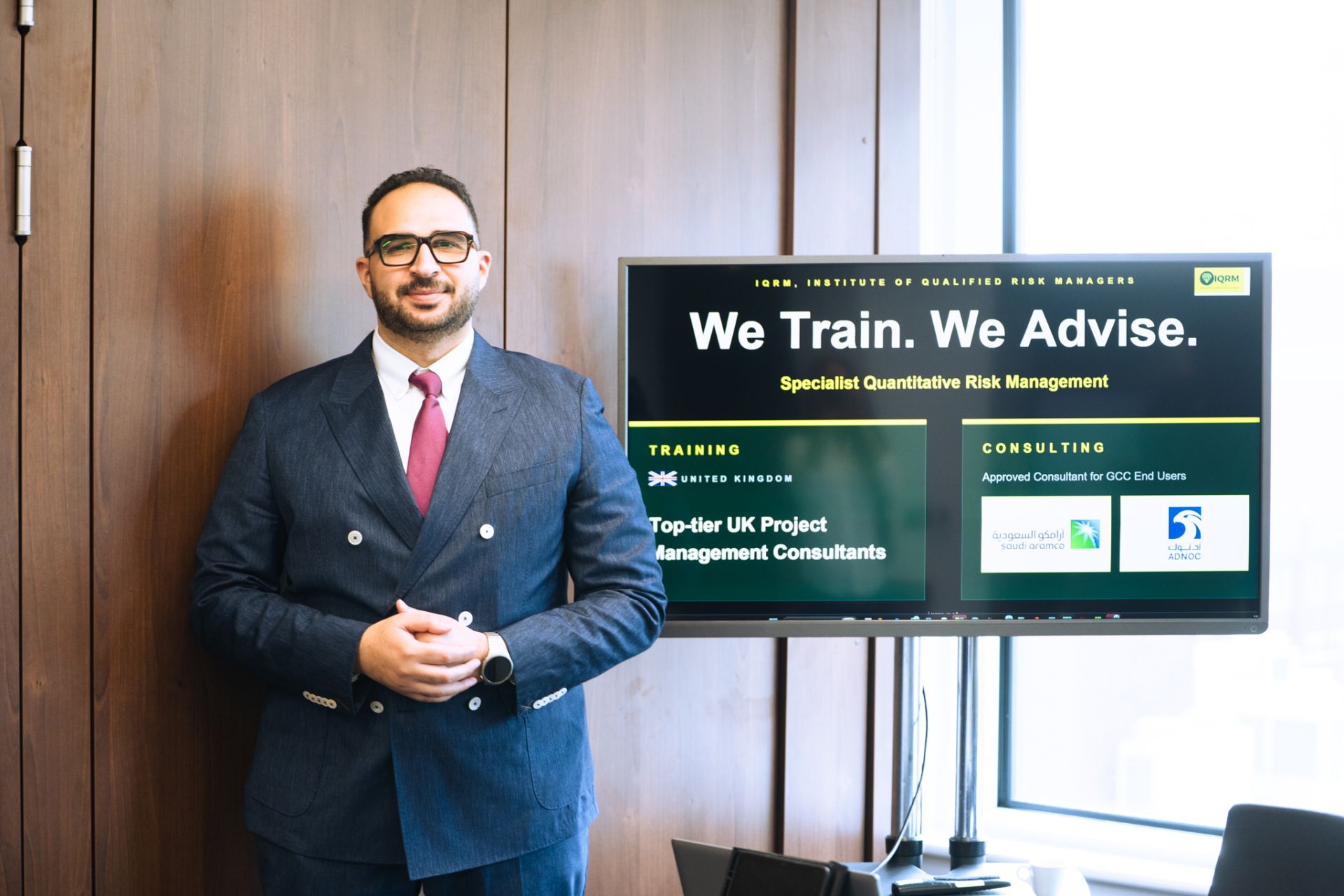
Rami Atef Salem, QRMCert
Rami has 15+ years in oil and gas risk management and is an Approved Consultant for both Saudi Aramco and ADNOC. He works in Safran Risk and advanced quantitative techniques every day, and has guided a large number of professionals through the move from qualitative to quantitative risk management.
You learn the method from someone who builds these models for real programmes, not someone teaching it from a textbook. The same methods are now used to train teams inside tier-1 PMC consultancies in the UK, several of whom already run QSRA and came to sharpen how they do it.
Watch · What we actually do
Every template and model we use is yours to reuse.
You do not start from a blank page on your next project. You leave with the working files from the training, the same templates and models, ready to drop straight into real work. The full toolkit, worth £159, is included at no extra cost.
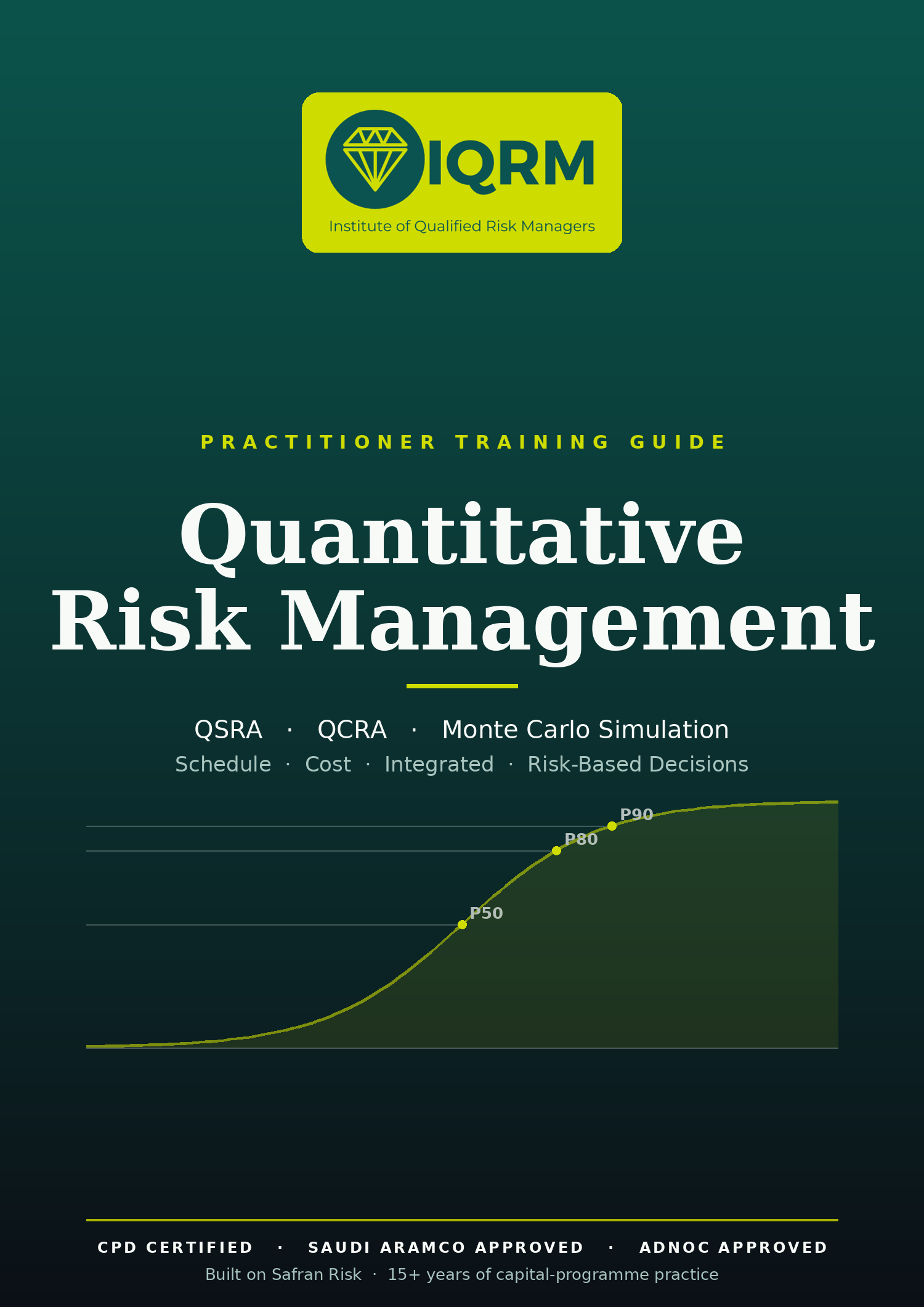
The complete QRM Guide, on your platform.
Every enrolment includes the IQRM Quantitative Risk Management Guide, a practitioner reference handbook that walks through the full QSRA, QCRA, integrated risk and decision-support method, step by step.
It is not a slide pack. It is a full reference you access any time inside the IQRM learning platform, throughout the programme and after it ends. Worth £90, included at no extra cost.
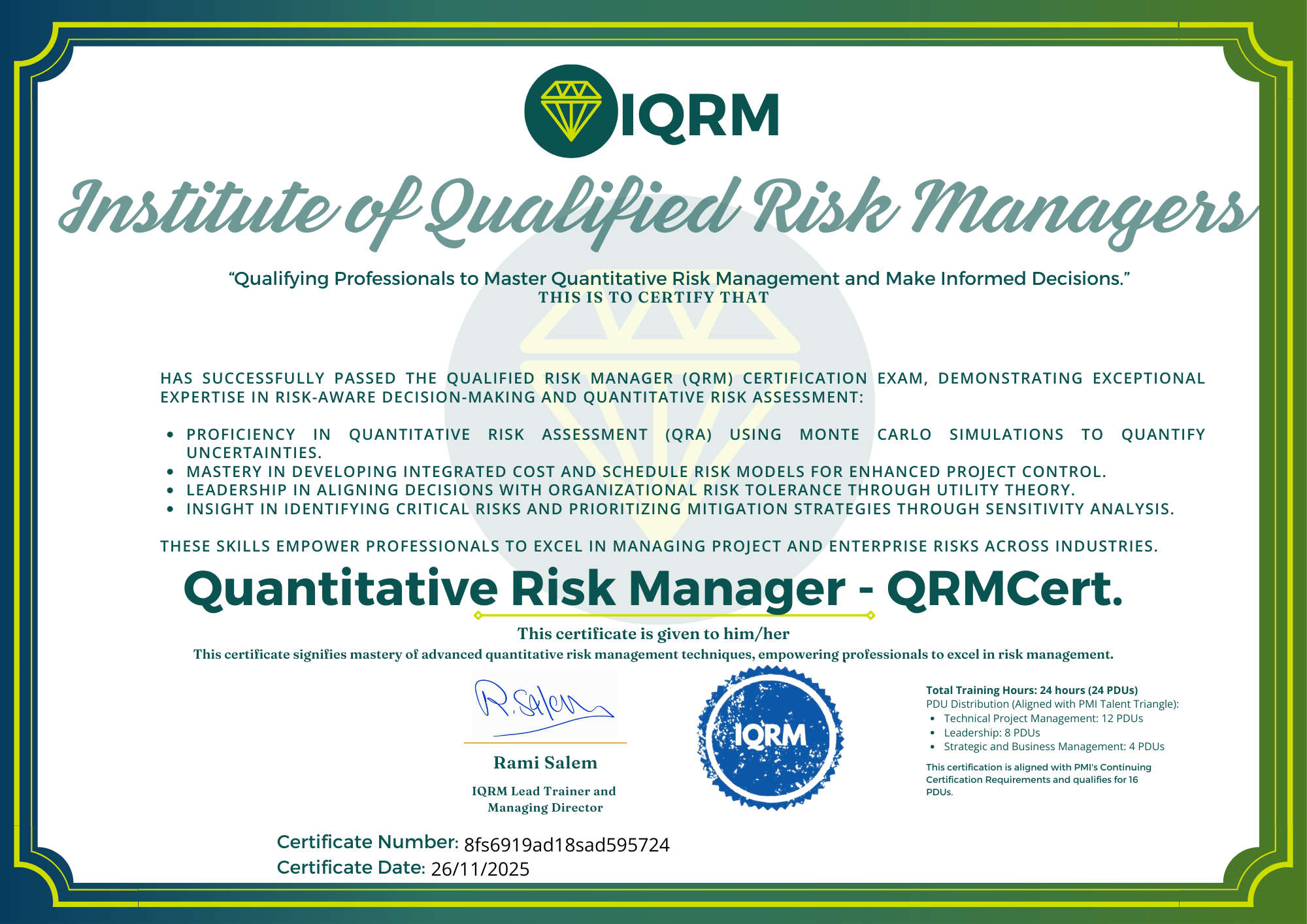
Earn the QRMCert. Proof you can run QSRA properly.
The QRMCert. is not a certificate of attendance. It is awarded only when you have completed the training, passed a proctored exam, and submitted a graded capstone project.
That makes it verifiable, globally recognised evidence that you can independently build and defend quantitative schedule and cost risk models, the capability employers across the UK and GCC are screening for.
Three ways to qualify.
The Hybrid programme runs continuously. There is no start date to wait for and no cohort to miss: you enrol, the full recorded programme unlocks immediately, and you join the next live advisory session whenever it falls. Sessions run every two weeks on Tuesday, 16:00 to 17:00 UK time, which is 18:00 Riyadh and 19:00 Dubai. Every session is recorded, and each one is capped at 18 so that every model brought to the room actually gets looked at.
Prefer to learn it live? The next live cohort starts Tuesday 6 October. Enrol by Monday 28 September and you are in the room.
Remember: these roles pay 12 to 16% more. On a £70,000 salary that is £8,400 to £11,200 a year. £499 to £895 is a fraction of one year of that uplift.
Templates worth £159. The QRM Guide worth £90. The QRMCert. and a placement introduction to PACE Global. Plus the skill that adds 12 to 16% to your salary. Your investment: £499 to £595.
- All 5 modules and recordings
- Capstone project and case-study dataset
- Reusable Schedule and Cost models
- Report and risk register templates
- Two-step certification path
- The full recorded programme, all modules, lifetime access
- Eight live advisory sessions with Rami, every two weeks on Tuesday, 16:00 to 17:00 UK
- Sessions cover whatever has not clicked, and you bring your own model for direct review
- Full refund after the first live session if it is not for you
- QRMCert. designation on completion
- All templates and the practitioner guide included
- Eight live build sessions with Rami, Tuesdays at 16:00 UK, 6 October to 1 December (no session on 3 November)
- Sessions 9 to 12 self-paced, plus two live capstone clinics
- Your capstone reviewed personally by Rami
- Exam and QRMCert. designation, CPD certified
- 30 days of Safran Risk, free
- Every session recorded. Full refund after session one if it is not for you
A practitioner reference covering the full QSRA, QCRA and risk-based decision method, available to you on the platform throughout the programme and beyond.
The first-session guarantee
Join the live cohort and sit the first session. If you decide the programme is not right for you, email us before session two and we will refund you in full, no questions asked. You risk nothing but two hours of your time. The risk sits with us, not you.
Two-step certification: CPD-assessed Certificate of Completion, then the QRMCert. professional certification after a proctored exam and graded capstone. Corporate cohorts available on request.
Need your whole risk team QSRA-capable?
Run a private corporate cohort built on your own project data, with a dedicated portal, progress tracking, and private office hours. Invoiced to your organisation. It is how tier-1 PMC consultancies upskill their teams.
Training a team? We run private cohorts on your own project data. Get in touch and we will send dates and pricing.
"The discussions encouraged participants to think critically about risk, uncertainty, modelling assumptions and decision-making, while providing practical insights that can be taken straight back into the workplace."
A. P., Head of Project and Programme Risk, after sending three of his team through the programme
Frequently asked.
Quantitative Schedule Risk Analysis (QSRA) is a Monte Carlo simulation method that quantifies how uncertainty and risk affect a project schedule. Instead of a single deterministic finish date, QSRA produces a range of outcomes and confidence levels (P50, P80, P90), identifies the top schedule risk drivers, and shows the impact of mitigation. This course teaches you to build and defend QSRA models independently.
QSRA (Quantitative Schedule Risk Analysis) quantifies risk to the project timeline, giving confidence levels for the completion date. QCRA (Quantitative Cost Risk Analysis) quantifies risk to the project budget, giving confidence levels for final cost. Integrated cost and schedule risk analysis (ICSRA) combines both into a joint confidence level (JCL). This programme covers all three.
No. We teach the maths you will actually use, distributions, sampling, and confidence. The only prerequisite is familiarity with project delivery and basic risk concepts.
No, and you do not need to buy anything to start. Every enrolment includes 30 days of Safran Risk free, so you build on the industry-standard tool from day one. The method is also demonstrated in Excel and transfers to Primavera Risk Analysis and Deltek Acumen Fuse, so nothing you learn is stranded when the trial ends or when your employer uses something else.
A qualitative review ranks risks. QSRA quantifies finish-date confidence such as P50, P80, and P90, identifies the top drivers, and shows the impact of mitigation using Monte Carlo simulation.
Yes, and this is the reason the programme is built the way it is. The training itself is self-paced and unlocks in full the day you enrol, so you fit it around delivery pressure rather than the other way round. The only fixed commitment is one live advisory session every two weeks, Tuesday 16:00 to 17:00 UK, and every session is recorded so nothing is lost if a meeting overruns.
Yes. There is a quiz after every session, exercises after each module, and a final exam. The QRMCert. professional certification is awarded only after a proctored exam and a graded capstone project.
Yes. We start from fundamentals and build up to QSRA, QCRA, and joint confidence level. It is built for application, so you will complete exercises and a capstone rather than attend passively.
Yes. The live advisory session runs every two weeks on Tuesday, 16:00 to 17:00 UK time. That is 18:00 in Riyadh and 19:00 in Dubai during British Summer Time, and 19:00 and 20:00 respectively once the UK clocks change in late October. Every session is also recorded, so you can catch up at any hour.
Nothing is lost. Every session is recorded and made available, so you can rewatch or catch up on your own schedule and still complete the exercises and capstone.
Yes. We can issue an invoice for your organisation to settle, and we run tailored corporate cohorts with a private portal and case data. Email info@iqrm.net to arrange it.
Get the full syllabus and cohort updates.
Download the detailed syllabus and we will let you know when the next cohort opens, plus practical QSRA and QCRA tips along the way. No spam, unsubscribe anytime.
Join 200+ professionals who have trained with IQRM.
99% of roles require QSRA. The question is how long you wait to get it.
The next live cohort begins Tuesday 6 October. 18 seats.
CPD certified · Approved Saudi Aramco vendor · ADNOC approved consultant
IQRM is a specialist institute for Quantitative Risk Management, delivering Quantitative Schedule Risk Analysis (QSRA), Quantitative Cost Risk Analysis (QCRA) and Monte Carlo simulation training and consulting to major capital projects across the United Kingdom, Saudi Arabia and the UAE.
QRM Training
Consulting
Knowledge Hub
QSRA on UK Major Projects
United Kingdom
QSRA & QCRA training and consulting for UK infrastructure, nuclear and energy programmes.
QSRA Training UK
info@iqrm.net
United Arab Emirates
Rolex Tower, Sheikh Zayed Road, Dubai
+971 50 362 5784
QSRA Training UAE
Saudi Arabia
Riyadh delivery for giga-projects and Vision 2030 programmes.
QSRA Training Saudi Arabia
info@iqrm.net