QRM Specialist + Professional, HYBRID
Certification pathway
Every skill a project risk manager is expected to have. Taught once, in the right order.
Most risk professionals can run the process or run the numbers. Very few can do both, and that is the gap that keeps them out of the room where the contingency is decided. This pathway teaches the complete set. Three weeks to a working model, then eight live reviews of your own work while you use it for real, and the QRMCert. at the end.
£1,044 bought separately, in one enrolment here. You save £250.
A real project case study is supplied, so you are never asked to share commercially sensitive material or seek internal approval to take part.
The gap
A register that scores a risk 4 by 3 cannot tell a project director when the project will finish. It describes worry. It does not price it.
The two halves of risk management are usually learned by two different people. One writes the plan, facilitates the workshop and maintains the register. The other builds the model and produces the S-curve. Neither can finish the sentence the other started, and the project pays for it at every gate.
And when a number finally does get produced, the first question in the room is never about the method. It is where did you get this data? Most risk professionals have no answer to that, which is why the analysis gets overruled by whoever sounds most confident.
You have watched what happens next. A project reports that it will catch up. It reports it again the following month, and the month after that, compressing the schedule like a spring, until the spring snaps and the report changes from "we will catch up" to "we are not delivering". Two years late. Nobody was lying. Nobody had the number that would have made the conversation happen eighteen months earlier.
Failure one
Documents without numbers
A complete, well-maintained register that produces no forecast. It satisfies the procedure and answers none of the questions leadership actually asks.
Failure two
Numbers without documents
A Monte Carlo model built on an uncalibrated register inherits every weakness in it. The output looks precise and defends nothing.
Failure three
Neither, under challenge
When the contingency is questioned, whoever can show how each input was derived keeps the number. Everyone else negotiates it away.
The market
The capability is now a screening criterion, not a differentiator.
"99% of the risk management roles we place in the UK require QSRA capability as a minimum."
Chirag Shah, PACE Global, the UK's leading project controls and risk recruitment firm
Three things get screened for on the roles worth having: QSRA experience, Monte Carlo simulation, and Safran Risk or equivalent. This pathway is built to satisfy all three, and to let you prove it with work you have actually done.
Premium and placement figures supplied by PACE Global. The multiple is calculated against the £794 pathway price. Individual outcomes vary and nothing here is a promise of a salary or a role.
The method
Three things you do not currently have.
Not two courses. Three capabilities, installed in order, each one making the next one possible.
Component one
A register that can carry a number.
Most registers cannot. Every risk statement separates cause, event and consequence. Every probability and impact scale is calibrated to the actual value of the project, not copied from the last one. Every owner is named and can be held to a response. This is the Quantification Readiness Standard, and it is the foundation. Skip it and everything above it inherits the weakness.
Component two
The Risk Data Engine.
Your answer to the question that kills more analysis than any technical error. It is a continuous read of the project's own uncertainty, taken from data you already produce weekly and monthly. Repetitive disruptions, like permit rejections and review cycles. Duration uncertainty, the real spread in productivity. Around ten to twelve parameters, collected on a set frequency, fitted to a distribution, fed into the model. When you are challenged, you do not defend an opinion. You point at a record.
Component three
The decision, not the chart.
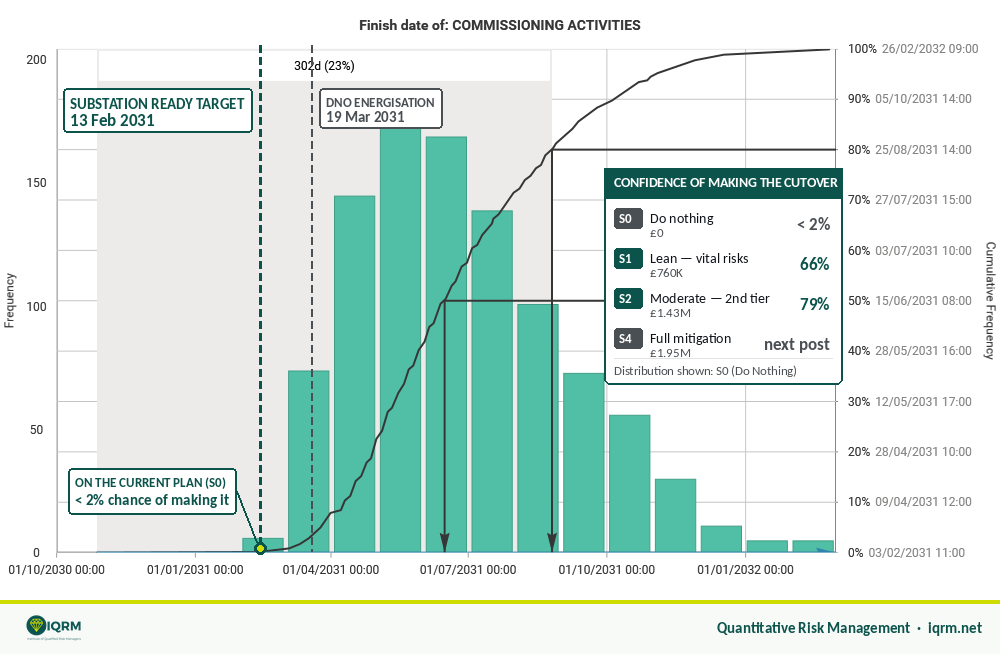
A tornado chart is not a decision. Neither is an S-curve. Both are inputs to a conversation you have to be able to hold. Which risks are actually moving the answer and which are noise. What P50, P80 and P90 mean to somebody who has to approve a number. What you say when a director asks why the contingency went up, and what you offer instead of "we will be three months late, add ten per cent".
Why it transfers
Taught from the practitioner's chair, not the lecturer's.
Typical software training
- Teaches which buttons to click in one tool
- Tied to a single piece of software
- You can run a model, but not defend it
- Knowledge expires when the tool updates
- No grounding in the judgement behind the numbers
The IQRM method
- Teaches the method beneath the software
- Transfers to Safran Risk, Primavera Risk Analysis and Deltek Acumen Fuse
- You build the model and defend the decision
- Skills that outlast any tool version or employer
- Built on 15+ years of real capital-programme practice
How it runs
Three weeks to a working model. Then eight live reviews of your own.
Two to three hours a week, built around people who already have a full time job on a live project, because everyone who takes this does. Nothing here is theory you wait months to apply. By week three you have four documents and a model you built yourself. What follows is where you point it at your own project, with somebody checking your work every fortnight. The order is not presentation. Stage 02 quantifies the exact artefacts you built in Stage 01, which is why people who arrive with a working register get far more out of a simulation course than people who do not.
Weeks 1 to 3 · you build
Three weeks, and you have built it.
The live cohort runs three sessions of two hours, one a week, timed for UK and GCC working days, with every session recorded and released the same evening. The QRM Professional Programme is self-paced and opens the day you enrol, so the quantitative modules run alongside the live sessions rather than after them. Work at that pace and by the end of week three you have the four documents and a working model built on the supplied capital project.
- Build 01, the Risk Management Plan. Eight sections, including the scales, the risk breakdown structure and the appetite every later score is measured against.
- Build 02, the Risk Register. Around 40 risk statements in WHY, WHAT, HOW form, separated into cause, event and consequence so they can be quantified later.
- Build 03, the Risk Workshop Facilitation pack. What you take into the room to get usable inputs out of engineers who would rather be somewhere else. This is where the numbers actually come from.
- Build 04, the Risk Status Report. The version a project director reads, plus a live review of your own register in the room.
Every two weeks after that · you are supported
Then somebody checks your work, eight times.
Building a model on a supplied case study is the easy part. Doing it on your own project, with your own data and your own PMO asking where the numbers came from, is not. That is what the Advisory Sessions are for. Eight of them, one every two weeks, Tuesday 16:00 to 17:00 UK, which is 18:00 in Riyadh and 19:00 in Dubai. You bring your own model, register or report, and it is reviewed. Every session is recorded, so a meeting that overruns costs you nothing. Recorded modules stay open with lifetime access, along with the 30 day Safran Risk licence, the Field Book and the models used on screen.
- Step 01, quantify the risks. You take the Risk Register you built in Stage 01 and turn scored risks into modelled events, mapped onto the schedule and the cost estimate.
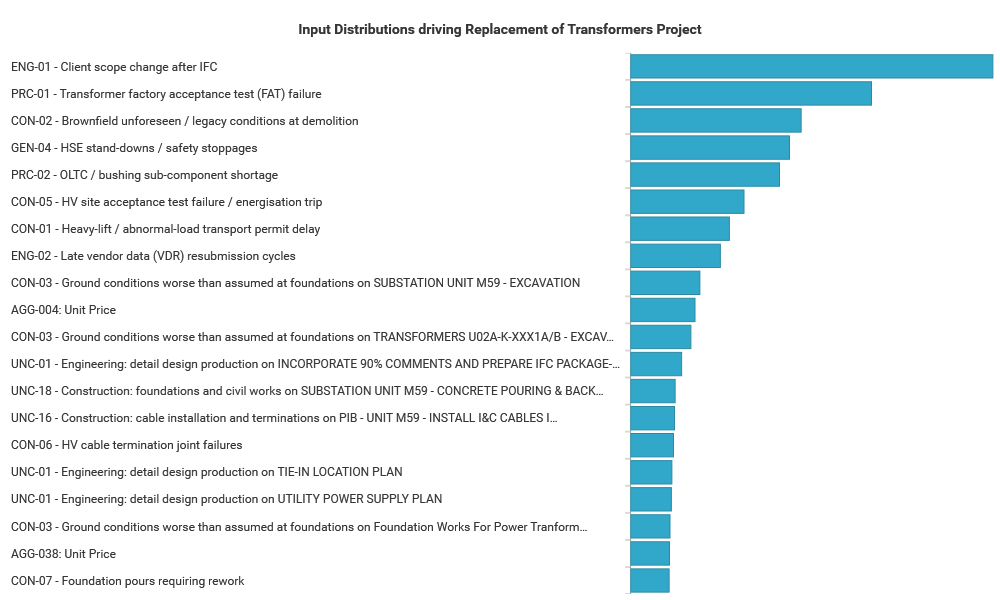
- Step 02, quantify the uncertainty. The Risk Data Engine. A risk may or may not happen. Uncertainty is happening 100 per cent of the time, and on most projects it is the uncertainty, not the register, that moves the date. The register gives you the events. The RDE gives you the ground they land on, and the model needs the ground first.
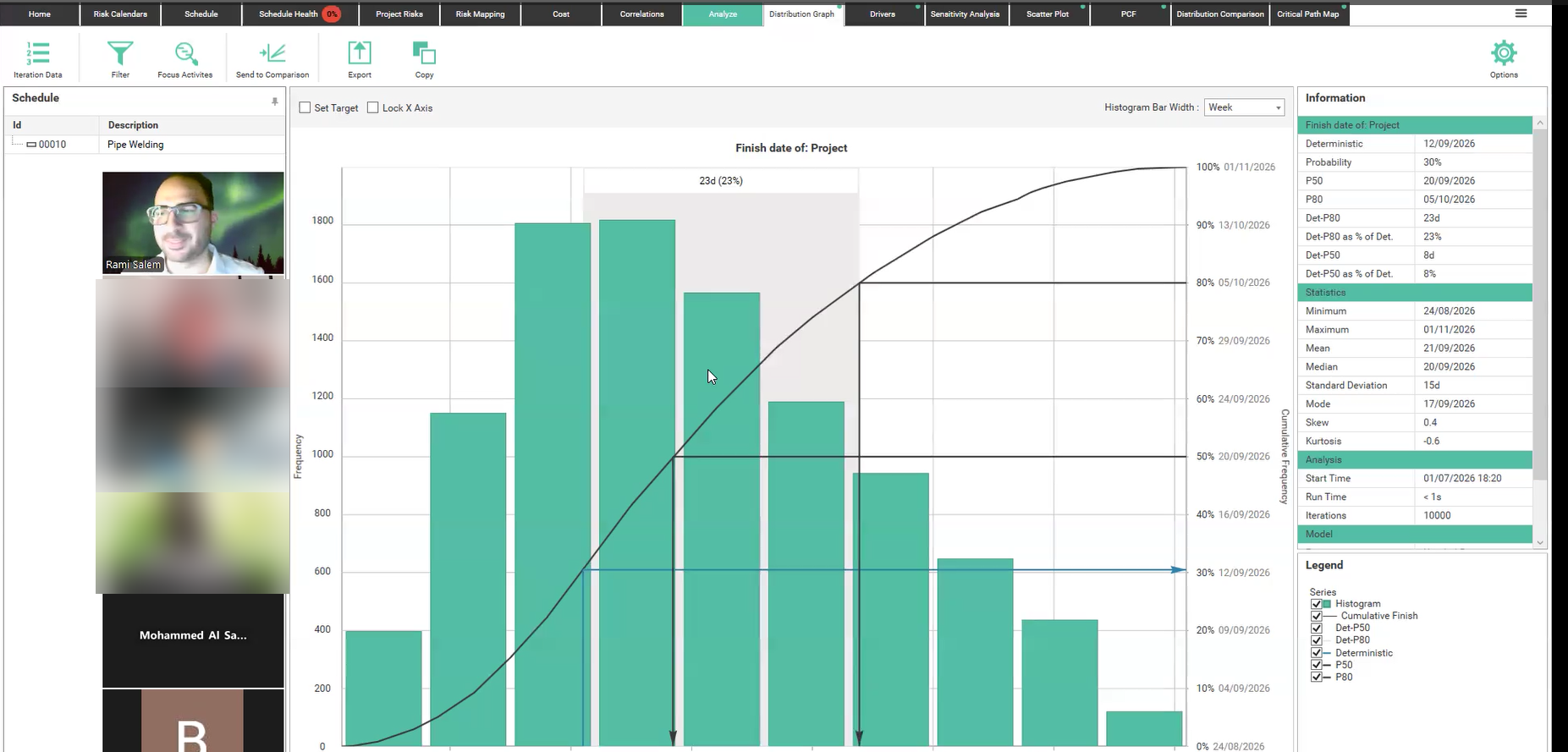
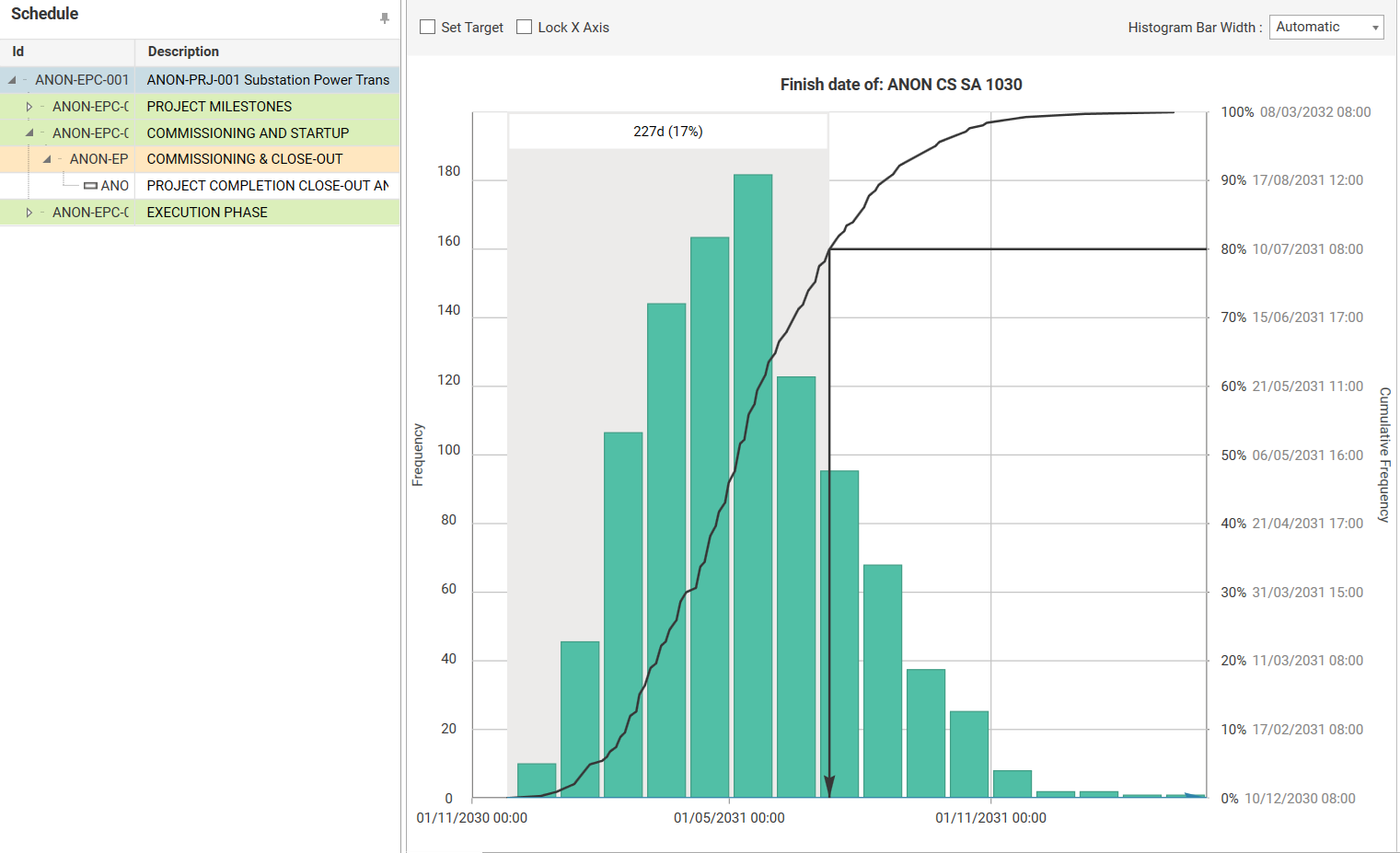
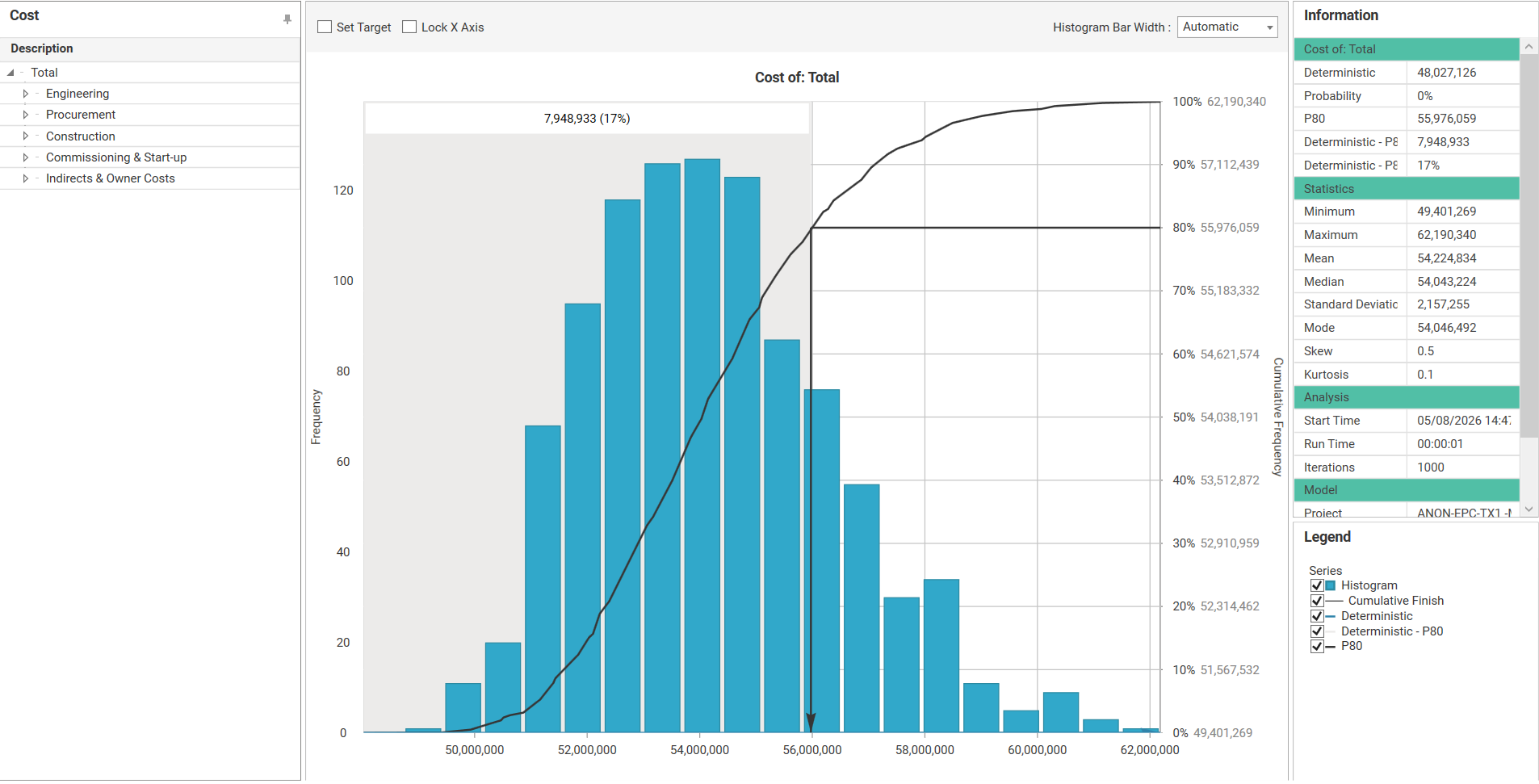
- Step 03, build the models. QCRA on the cost, QSRA on the schedule, then the two integrated with correlation and a joint confidence level.
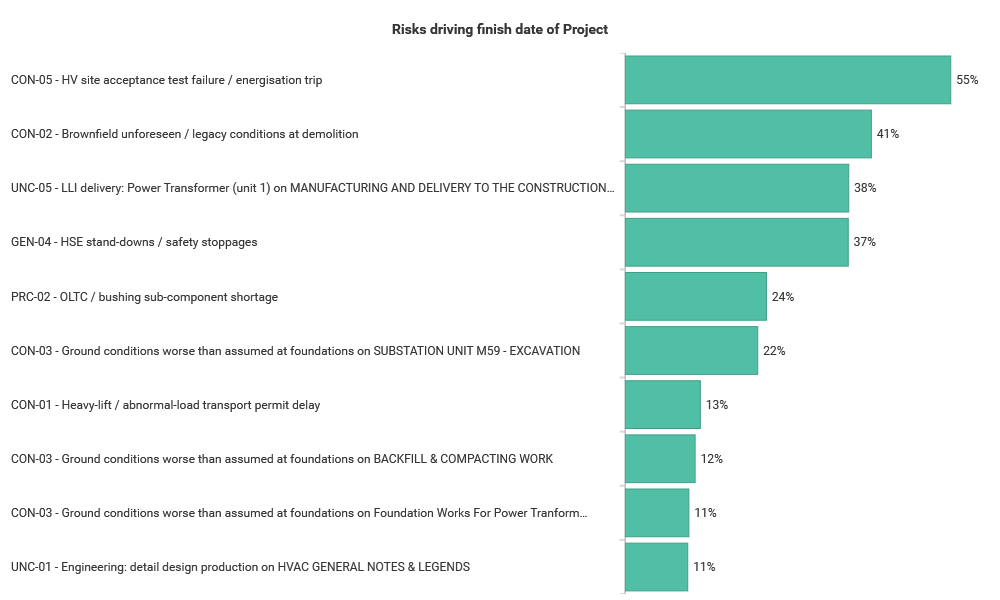
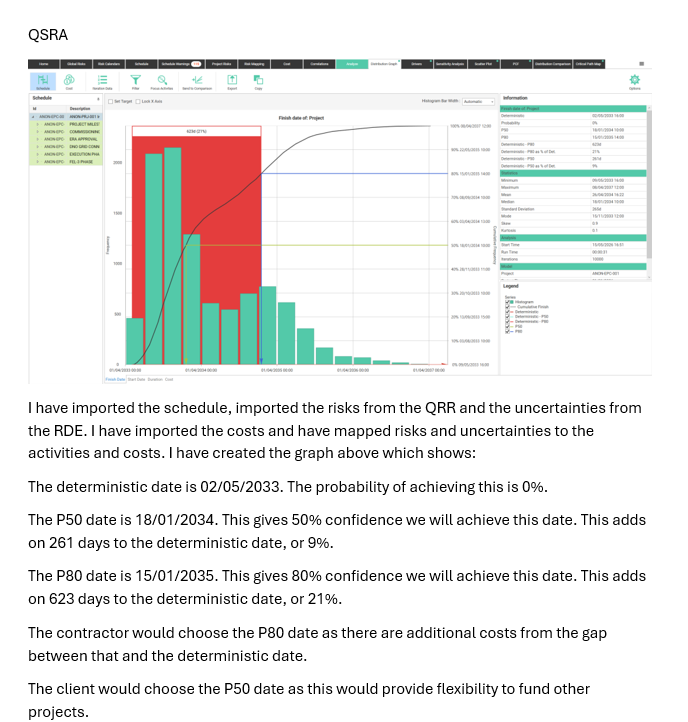
- Step 04, navigate the decision. Drivers and sensitivity, P50, P80 and P90 read correctly, and a recommendation a stakeholder can act on. This is the part that makes the other three worth doing.
Whenever you are ready · the award
You submit the model, and IQRM certifies it.
There is no waiting and no fixed sitting. Once you have submitted your model you can sit the QRMCert. whenever it suits you. Take your report into an Advisory Session first if you want it challenged the way a live project will challenge it. Where did this number come from. Why is P80 the right basis. Which three risks are driving it. There is no separate fee for the exam or the capstone. What the designation certifies is the full span, from the risk statement to the confidence level, which is precisely the span most risk qualifications leave in two halves.
By the end, there is no part of the job you have to hand to somebody else.
This is what a project risk manager is actually asked to do on a capital project. The pathway covers all of it, and nothing outside it.
- Write a risk statement that separates cause, event and consequence
- Elicit and defend three-point estimates
- Calibrate probability and impact scales to project value
- Build and run a quantitative schedule risk analysis
- Build a risk breakdown structure
- Build and run a quantitative cost risk analysis
- Write and own an eight-section risk management plan
- Integrate cost and schedule and apply correlation
- Facilitate a workshop that produces usable inputs
- Identify the real risk drivers with sensitivity analysis
- Maintain a register a model can actually run on
- Derive contingency and defend it at P50, P80 and P90
- Assign risk owners and hold them to a response
- Report a confidence level to a steering committee
Deliverables
You finish with work, not notes.
Every stage produces artefacts you can put in front of a project. That is the test the programme is built around, and it is the reason a real capital project case study is supplied to everyone.
From Stage 01
- An eight-section Risk Management Plan
- A populated register, around 40 quantification-ready statements
- Calibrated probability and impact scales tied to project value
- A risk breakdown structure
- A Risk Workshop Facilitation pack
- A one-page Risk Status Report
- Four reusable templates in Excel and Word
From Stage 02
- A working QSRA model on the case study project
- A working QCRA model with derived contingency
- An integrated cost and schedule model with correlation
- Tornado and driver analysis
- An S-curve with P50, P80 and P90 read correctly
- A senior-management risk report
- 30 days of Safran Risk and the IQRM Field Book
Your project data never leaves your organisation.
A real capital project case study is supplied to every delegate. You are never asked to share commercially sensitive material, and you do not need internal approval to take part. That single blocker stops more people enrolling than price does.
The award
What the QRMCert. actually says about you.
Certificates are only worth what they certify. The QRMCert. is issued by the Institute of Qualified Risk Managers and is awarded only after a proctored exam and a graded capstone project, which means it evidences a specific and unusually complete capability rather than attendance at a course.
What it evidences
The full span
That you can write a quantification-ready risk statement, build the register and the plan around it, model it, and explain the confidence level to the people who sign.
How it is earned
Sat when you are ready
Submit your model and sit the proctored exam whenever it suits you. No fixed date, no waiting for a cohort, and no separate fee. It is assessed, which is why it is not a certificate of attendance.
Why employers fund it
One line item
A single purchase covering two programmes and a named award is far easier to get approved than three separate requests. A quotation on letterhead is available on request.
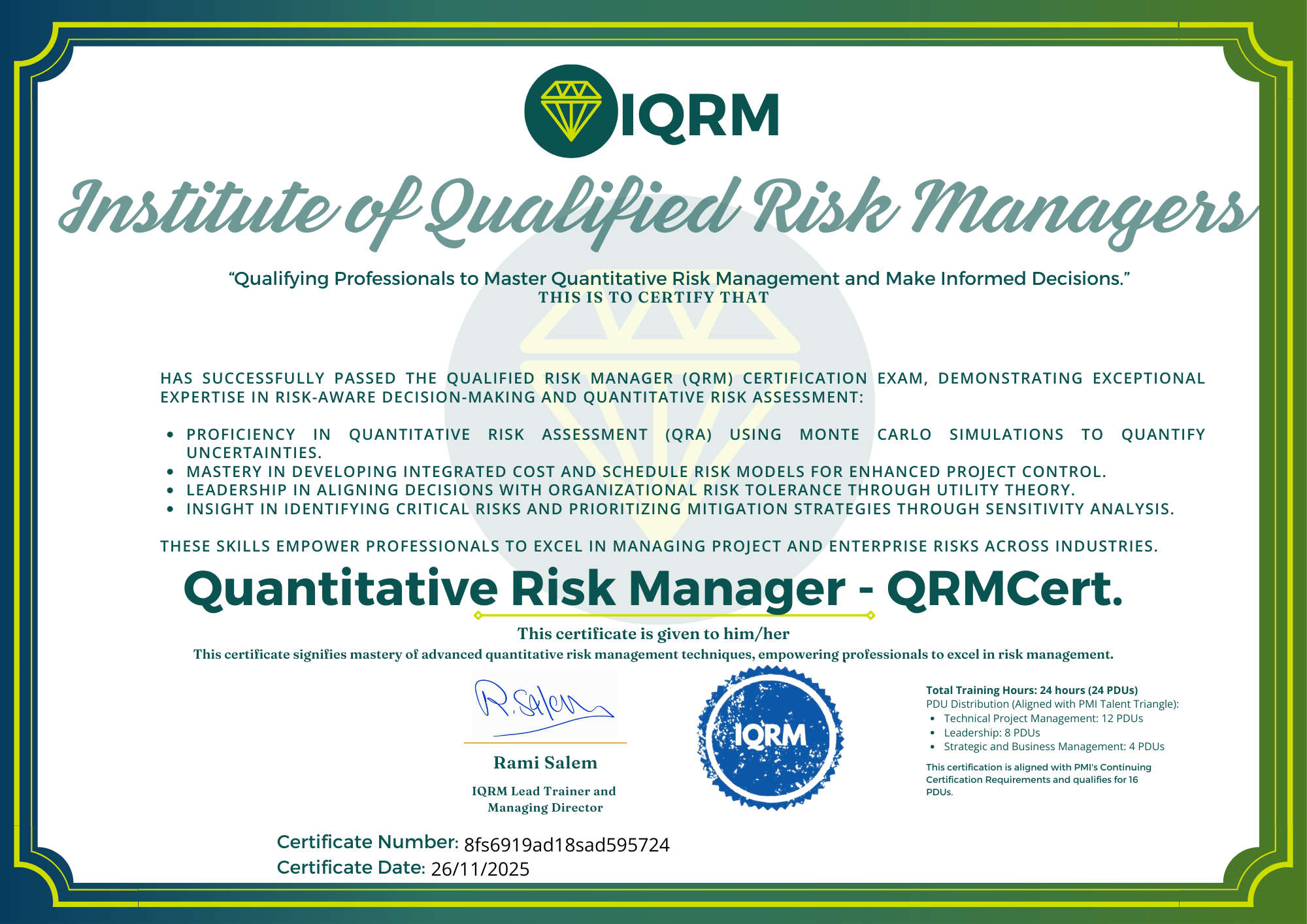
This is what arrives at the end.
The QRMCert. designation, issued by the Institute of Qualified Risk Managers. It goes on your profile, into an appraisal, and into the next tender your employer bids for.
It is awarded only after a proctored exam and a graded capstone project, which is what separates it from a certificate of attendance. Both are included. A paywall on your own result is not certification, it is a toll.
Proof
200 professionals trained. Now working across major programmes.
Written by people who do this work for a living.
Every review below is from a delegate on the QRM Professional Programme, the quantitative half of this pathway. Nothing here is retyped or edited.
"There is a gap in the market for people that can do QRA, particularly QSRA, and an even bigger gap for people that can teach it well. Rami can do that."
J. S., MBCI, Risk and Assurance Manager, JET Decommissioning and Repurposing Programme, UKAEA
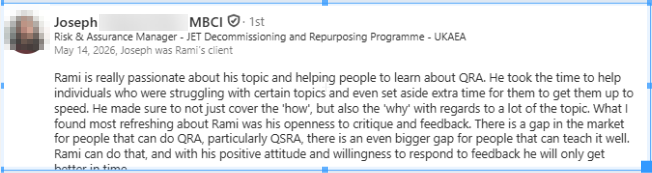
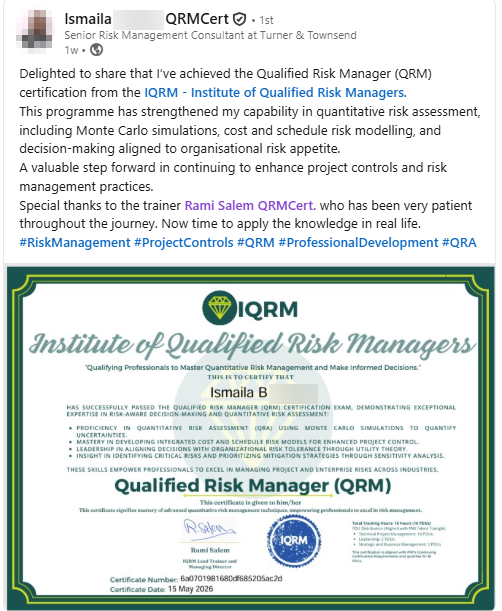
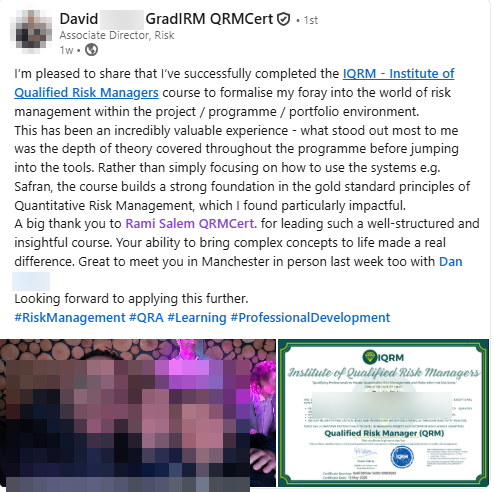
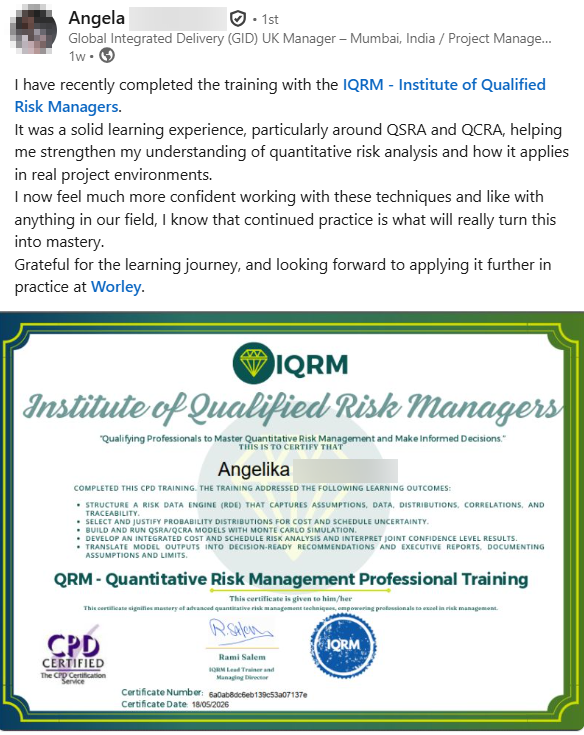
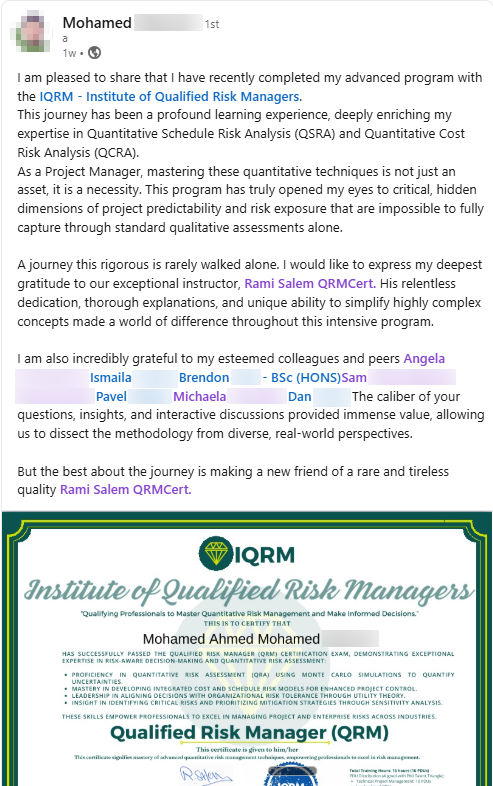
Unedited, straight from LinkedIn. UKAEA, Turner and Townsend, Worley.
And what happened next
Past delegates did not just finish the course. They moved.

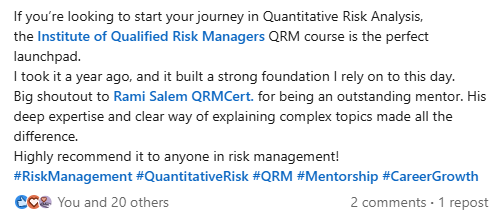
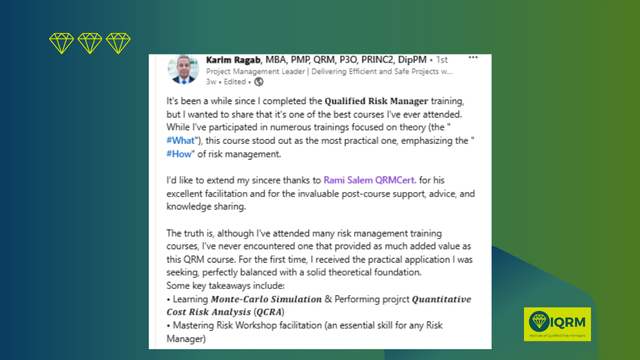
Career outcomes reported by past delegates.
A QRM graduate on what changed after certification.
The method is published, not asserted.
IQRM writes the standards it teaches. Both are public documents, so the method behind this pathway can be examined before you pay for it.
Standard
The Quantification Readiness Standard
The test a risk register has to pass before a Monte Carlo model built on it means anything. Stage 01 is built to satisfy it.
Method
The Risk Data Engine
How subjective inputs become defensible distributions. The reason Stage 02 produces numbers that survive challenge.
Career pathway
Eligible UK graduates are introduced to PACE Global.
Through IQRM's partnership with PACE Global, the UK's leading project controls and risk recruitment firm, eligible UK graduates are introduced for placement into risk management roles that require QSRA. Introductions are subject to eligibility and PACE Global's own selection process.
Who teaches it
One practitioner, not a faculty.
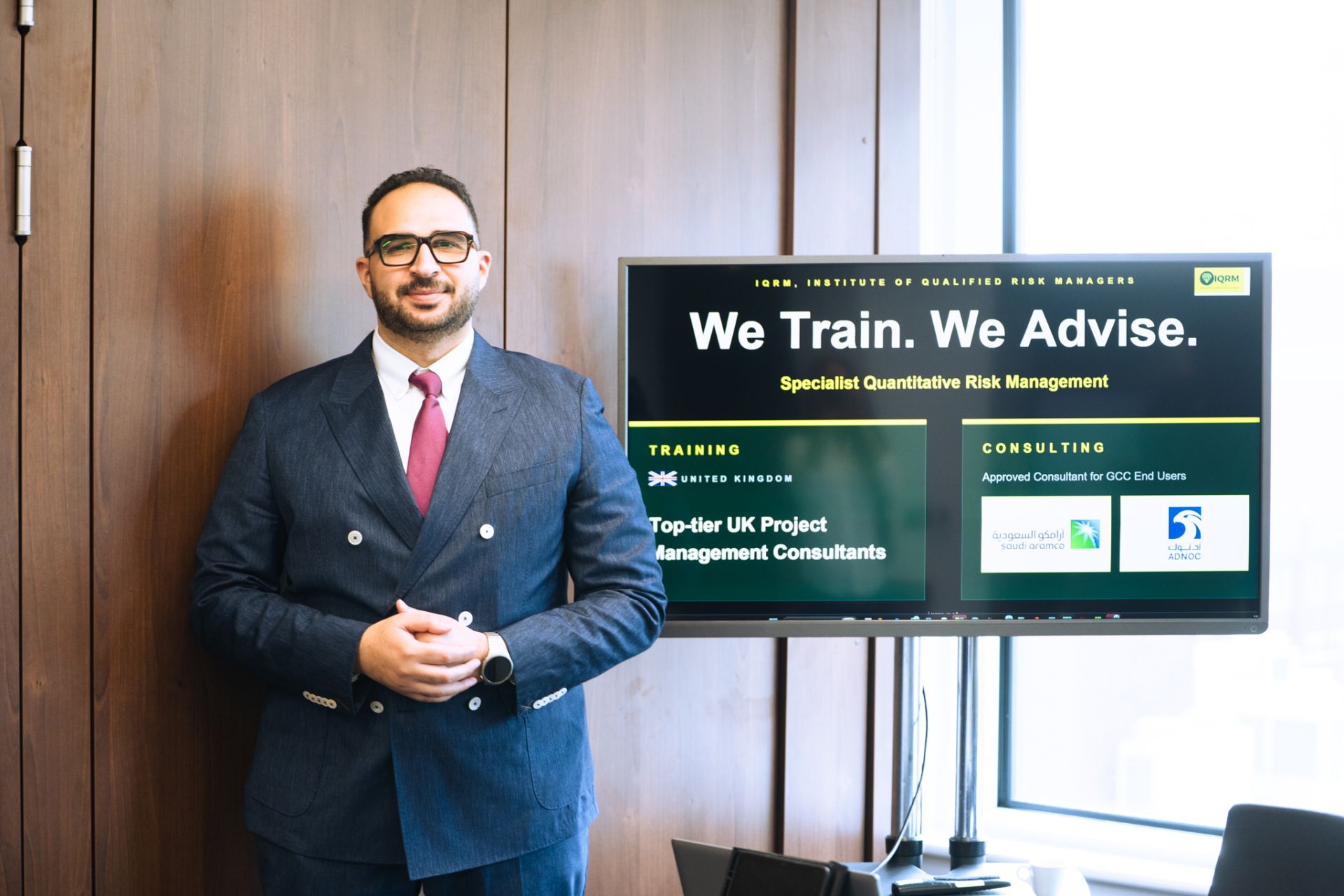
Rami Atef Salem, QRMCert
Founder, Institute of Qualified Risk Managers
Fifteen years and more of quantitative risk on capital projects in oil and gas, EPC and infrastructure, across the UK and the GCC. Approved Saudi Aramco vendor and ADNOC approved consultant.
He wrote the Quantification Readiness Standard and the Risk Data Engine, and he teaches every session and reviews every model personally. When your work is challenged in an Advisory Session, it is challenged by the person who built the method, not by a facilitator working from a deck.
Three weeks from now you could have a working model, and eight fortnightly reviews of it ahead of you.
£1,044 bought separately. Or keep reading, the FAQs and what is not promised are all below.
Investment
One enrolment. Both programmes. The certificate.
The QRM Certification Pathway
£794
Three products, one payment, one line on a purchase order.
Three products, one enrolment.
Product 01
QRM Specialist Training, live
Live cohort online over three weeks. Three sessions of two hours, seats capped, your own register reviewed in the room. All four builds, four Excel and Word templates, recordings released the same evening.
Product 02
QRM Professional Programme, self-paced
The full quantitative programme, self-paced, open from the day you enrol, with lifetime access. QSRA, QCRA, integrated cost and schedule, correlation, sensitivity and reporting. Includes a 30 day Safran Risk licence, the IQRM Field Book and the models used on screen.
Product 03
8 live Advisory Sessions
One every two weeks, Tuesday 16:00 to 17:00 UK, eight of them. Bring your own model, register or report and have it reviewed by name. This is the part recordings cannot give you, and it is the difference between finishing a course and finishing a model.
Worth putting next to each other. The saving is £250. The capability it certifies carries a 12 to 16 per cent salary premium, which is £8,400 to £11,200 a year on a £70,000 salary. The saving is the smaller reason to move.
Also included at no extra cost: a real capital project case study, and the QRMCert. exam and capstone, with no separate fee.
Bought separately the three products cost £1,044. One enrolment here is £794.
Live cohort seats are capped. Stage 02 begins the moment you enrol.
Employer paying? Procurement will not catch you out.
Request a quotation and the £794 is held while it goes through approval, however long your procurement takes. Quotations are issued on IQRM letterhead the same working day, with the pathway as a single line item.
The first-session guarantee.
Sit the first live session. If you decide the programme is not right for you, email us before session two and we will refund you in full, no questions asked. You risk nothing but two hours of your time. The risk sits with us, not with you.
Straight answer
What is promised, and what is not.
Your money is protected by the first-session guarantee above. Your outcome is not, and it would be dishonest to pretend otherwise. It depends on whether you do the work between the sessions, and there is no way of knowing that in advance. Past delegates have moved into better roles and will tell you so themselves, but their result was theirs and salary figures on this page are market data, not a promise.
What is promised is specific and checkable.
- You will build four documents and three models on a real capital project, not case-study fragments.
- Your own work will be reviewed live, by name, eight times.
- The method is published. Read the Quantification Readiness Standard and the Risk Data Engine before you pay anything, and decide for yourself whether it is sound.
- The QRMCert. is assessed, by proctored exam and a graded capstone, with no separate fee for either.
That is as much as can honestly be promised, and it is more than most training puts in writing.
Questions
Before you enrol.
Do I have to take the two stages in order?
It is strongly recommended. Stage 02 quantifies the artefacts built in Stage 01, and delegates who arrive with a working register get considerably more out of the modelling work. If your register is already calibrated you can run the two in parallel, but the certificate requires both.
I already work in quantitative risk. Is Stage 01 wasted on me?
Ask yourself a narrower question: can you defend how your probability and impact scales were calibrated to project value, and can you show that each risk statement separates cause, event and consequence? If not, Stage 01 is repairing the exact inputs your models currently inherit. If yes, the QRM Professional Programme on its own may be the better purchase and we will say so.
Can I really finish the training in three weeks?
Yes, if you want to. The live cohort runs over three weeks and the QRM Professional Programme is self-paced and open from the day you enrol, so both can run in parallel at around two to three hours a week. Nothing forces that pace. Course access does not expire and the Advisory Sessions run every two weeks regardless, so if a live project takes over for a fortnight you simply pick it back up.
Do I need paid software?
No, and you do not need to buy anything to start. Excel and Word cover Stage 01. Every enrolment includes 30 days of Safran Risk free, so you build on the industry-standard tool from day one. The method is also demonstrated in Excel and transfers to Primavera Risk Analysis and Deltek Acumen Fuse, so nothing you learn is stranded when the trial ends or when your employer uses something else.
Do I need a statistics background?
No. We teach the maths you will actually use: distributions, sampling and confidence. The only prerequisite is familiarity with project delivery and basic risk concepts.
I am in the GCC. Does the schedule work for me?
Yes. The live Advisory Session runs every two weeks on Tuesday, 16:00 to 17:00 UK time. That is 18:00 in Riyadh and 19:00 in Dubai during British Summer Time, and 19:00 and 20:00 respectively once the UK clocks change in late October. Every session is recorded, so you can catch up at any hour.
When can I sit the QRMCert.?
Whenever your model is ready. There is no fixed exam date and no cohort to wait for. Submit your capstone model, sit the proctored exam at a time that suits you, and the designation is issued. Most people sit it once their own project model has been through an Advisory Session, but nothing obliges you to wait that long.
Is the certificate tied to real competence?
Yes, and that is the point of it. There is a quiz after every session, exercises after each module, and a final exam. The QRMCert. designation is awarded only after a proctored exam and a graded capstone project. It is not a certificate of attendance, and there is no separate fee for either assessment.
What if I cannot attend a live Stage 01 session?
Every session is recorded and released the same evening. Sessions are timed for UK and GCC working days. The one element you cannot recover from a recording is the live review of your own register, so tell us in advance and it is picked up in one of your Advisory Sessions instead.
Will this teach me a specific industry?
It is built on capital projects in oil and gas, EPC and EPCM, infrastructure and rail, power and brownfield work. It is not enterprise risk management, not process safety, and not financial or pharmaceutical quality risk. A risk statement either separates cause, event and consequence or it does not, and a scale is either calibrated or copied. None of that is sector knowledge.
What happens after the eight Advisory Sessions?
Nothing you own goes away. Course access, recordings, models, templates and the QRMCert. are permanent. What ends is the live review, and by that point you have had eight of them on your own work. If you want the reviews to continue, QRM Advisory Sessions are available separately on a monthly or annual basis.
Can my employer pay?
Yes, and it is the most common route. A quotation on IQRM letterhead is issued on request with the pathway as a single line item, which is usually easier to approve than separate course requests.
Is my project data safe?
Nothing you hold is ever requested. A real capital project case study is supplied to every delegate, so no commercially sensitive material changes hands and no internal approval is required to participate.
Enrol
The next time your contingency is challenged, be the one who can answer.
Every project decision is made under uncertainty. Very few are made with it measured. Three weeks to build, eight live reviews after that, and a designation that evidences the whole span rather than half of it.
Three weeks to build. Eight live reviews after that. Live cohort seats are capped.
Institute of Qualified Risk Managers
Learning program contents
IQRM is a specialist institute for Quantitative Risk Management, delivering Quantitative Schedule Risk Analysis (QSRA), Quantitative Cost Risk Analysis (QCRA) and Monte Carlo simulation training and consulting to major capital projects across the United Kingdom, Saudi Arabia and the UAE.
QRM Training
Consulting
Knowledge Hub
QSRA on UK Major Projects
United Kingdom
QSRA & QCRA training and consulting for UK infrastructure, nuclear and energy programmes.
QSRA Training UK
rs@iqrm.net
United Arab Emirates
Rolex Tower, Sheikh Zayed Road, Dubai
+971 50 362 5784
QSRA Training UAE
Saudi Arabia
Riyadh delivery for giga-projects and Vision 2030 programmes.
QSRA Training Saudi Arabia
rs@iqrm.net